• About Us
  • Conservation
  • Monitoring
  • Online Courses
  • Workshops
  • Publications
  • Shop
Menu
  • About Us
  • Conservation
  • Monitoring
  • Online Courses
  • Workshops
  • Publications
  • Shop

Launch of a new online solitary bee identification course

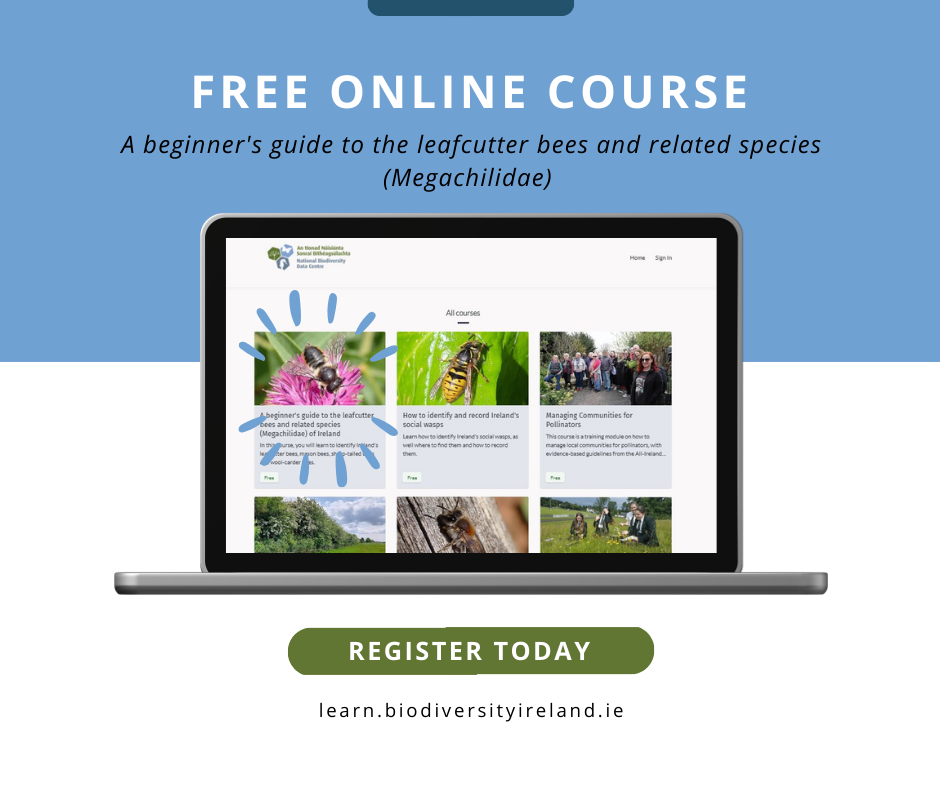
The National Biodiversity Data Centre is delighted to announce the launch of a new online course on Ireland’s leafcutter bees, mason bees, sharp-tailed bees and wool carder bees.

Ireland is home to over 100 different bee species, most of which are solitary. Unlike bumblebees or the Honey Bee, these bees do not form colonies, instead they choose to nest solitarily. They are important pollinators and many of them are among our most widespread and familiar solitary bees.

Solitary bee declines

With many of our pollinating insects threatened by habitat loss, our need to understand their whereabouts and population status in Ireland has never been greater. Many of our solitary bees have suffered from the removal of native woodlands and the loss of species-rich grasslands, heathlands and coastal dunes. This can reduce the abundance of native wildflowers and the number of available nesting sites which our solitary bees depend on.

The importance of citizen science

The course includes tips on where to find these solitary bees, how to identify them as well as an overview on submitting records on the National Biodiversity Data Centre’s Citizen Science Portal. With more citizen scientists recording solitary bees, we can build a more accurate picture of how these important pollinators are faring. The value of citizen science has already been demonstrated with the discovery of the Wool Carder Bee (Anthidium manicatum) and several other solitary bees in Ireland over the past 10 years, all thanks to you!

Enrolling in the course

With spring just around the corner, many of our solitary bees are starting to emerge, so now is the perfect time to enroll in the course and improve your identification skills. The course is completely free and can be accessed on the National Biodiversity Data Centre’s online learning platform here: A beginner’s guide to the leafcutter bees and related species (Megachilidae) of Ireland 
  • Contact Us
  • 051 306 240
  • National Biodiversity Data Centre
    Beechfield House,
    South East Technological University West Campus,
    Carriganore,
    Co. Waterford,
    Ireland.
    X91 PE03


The National Biodiversity Data Centre is a Company Limited by Guarantee with Charity status.

Registered Charity Number: 20206927

Heritage council logo


  • Privacy
We made this!
  • Home
  • About
    • Strategic Objectives
    • Global Biodiversity Information Facility
      • Ireland’s GBIF profile
      • The GBIF Network
      • Latest news at GBIF
      • GBIF Science Review
  • Monitoring & tracking change
  • Assisting conservation
  • Ireland’s Biodiversity Learning Platform
  • Training Events and Workshops
    • Online Courses
    • Events & Workshops
    • Join the Mailing List
  • Publications
  • Biodiversity Ireland’s Top 10
  • Local communities & NGOs
  • Farmers
  • Public Bodies
  • Researchers
  • Videos
  • Shop
  • News and Events
  • Procurement
  • Jobs & Opportunities
  • Data Standards
We use cookies on our website to give you the most relevant experience by remembering your preferences and repeat visits. By clicking “Accept”, you consent to the use of ALL the cookies. However you may visit Cookie Settings to provide a controlled consent. You can view our privacy policy here.
Cookie settingsACCEPT
Privacy & Cookies Policy

Privacy Overview

This website uses cookies to improve your experience while you navigate through the website. Out of these cookies, the cookies that are categorized as necessary are stored on your browser as they are essential for the working of basic functionalities of the website. We also use third-party cookies that help us analyze and understand how you use this website. These cookies will be stored in your browser only with your consent. You also have the option to opt-out of these cookies. But opting out of some of these cookies may have an effect on your browsing experience.
Necessary
Always Enabled
Necessary cookies are absolutely essential for the website to function properly. This category only includes cookies that ensures basic functionalities and security features of the website. These cookies do not store any personal information.
Non Necessary
Any cookies that may not be particularly necessary for the website to function and is used specifically to collect user personal data via analytics, ads, other embedded contents are termed as non-necessary cookies. It is mandatory to procure user consent prior to running these cookies on your website.
Save & Accept