
The Farmer Moth Monitoring Programme is a citizen science scheme for farmers to enable them to record moths on their farm. The scheme is managed by the National Biodiversity Data Centre and funded by the Department of Agriculture, Food and the Marine.
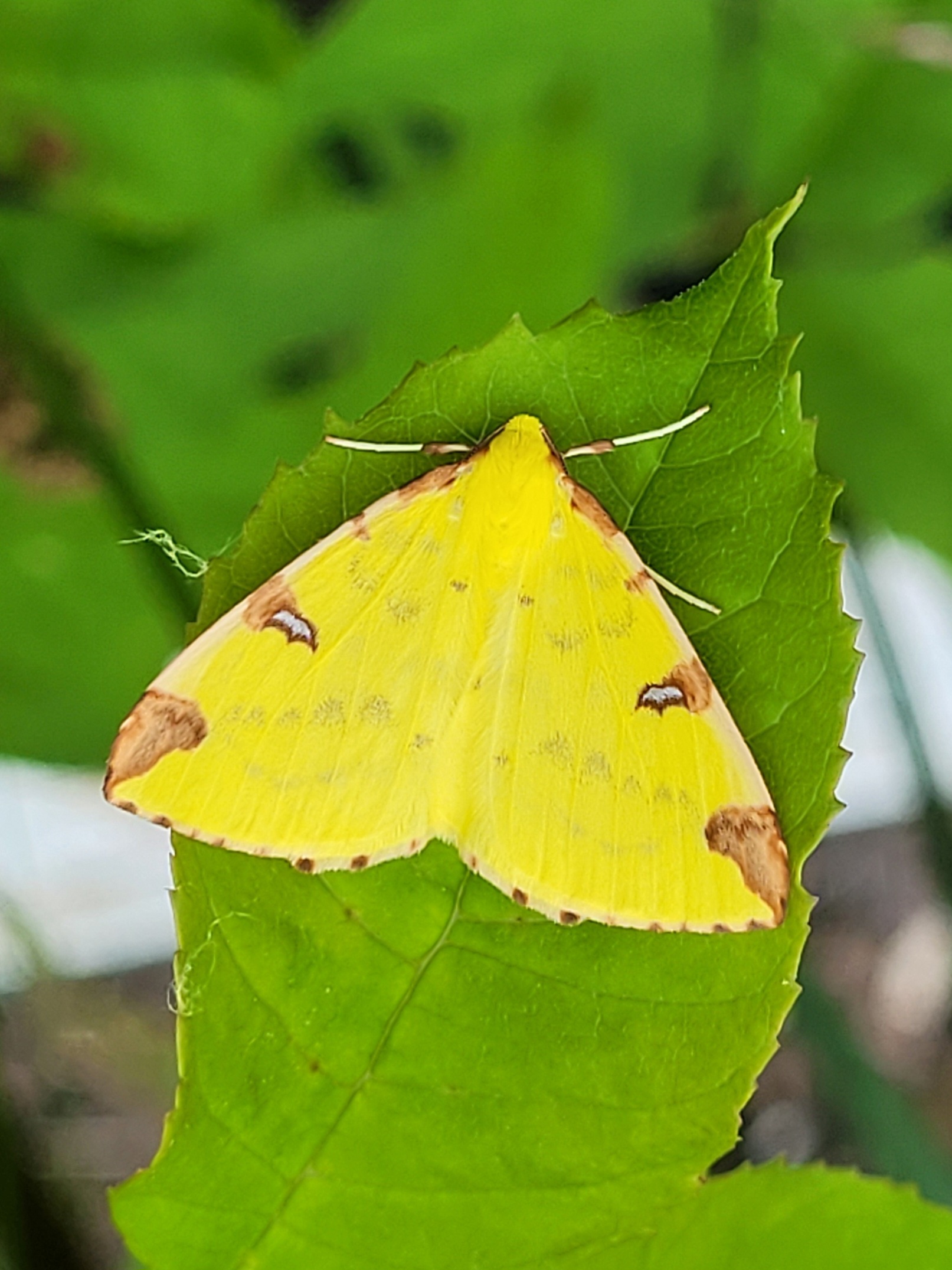
Brimstone (Opisthograptis luteolata) (Photo: Tim Butter)
Why do moths matter?
Moths are very important pollinating insects alongside bees and hoverflies but, because most species are active at night, we seldom see them visiting flowers. However, unfortunately, like other pollinating insects, moths are in decline. We have information on moth populations in gardens and in semi-natural habitats such as woods, bogs, and sand dunes, but actually very little data relating to moths on farmland, even though agriculture is the dominant land use in Ireland.
The All-Ireland Pollinator Plans seek to change land management to improve conditions for our pollinating insects. The Farmer Moth Monitoring Programme will provide data to help us understand how effective these actions are in boosting nocturnal pollinator populations.
However, moths are more than just pollinators. Moth caterpillars eat plants and are very important in converting plant matter into animal biomass. Although moth numbers in general have gone down over the past few decades, some moth species still occur in high numbers, and they support a wide range of smaller predators. These include bats and many birds. Some bird species time the hatching of their eggs to coincide with the peak numbers of moth caterpillars to feed their chicks.
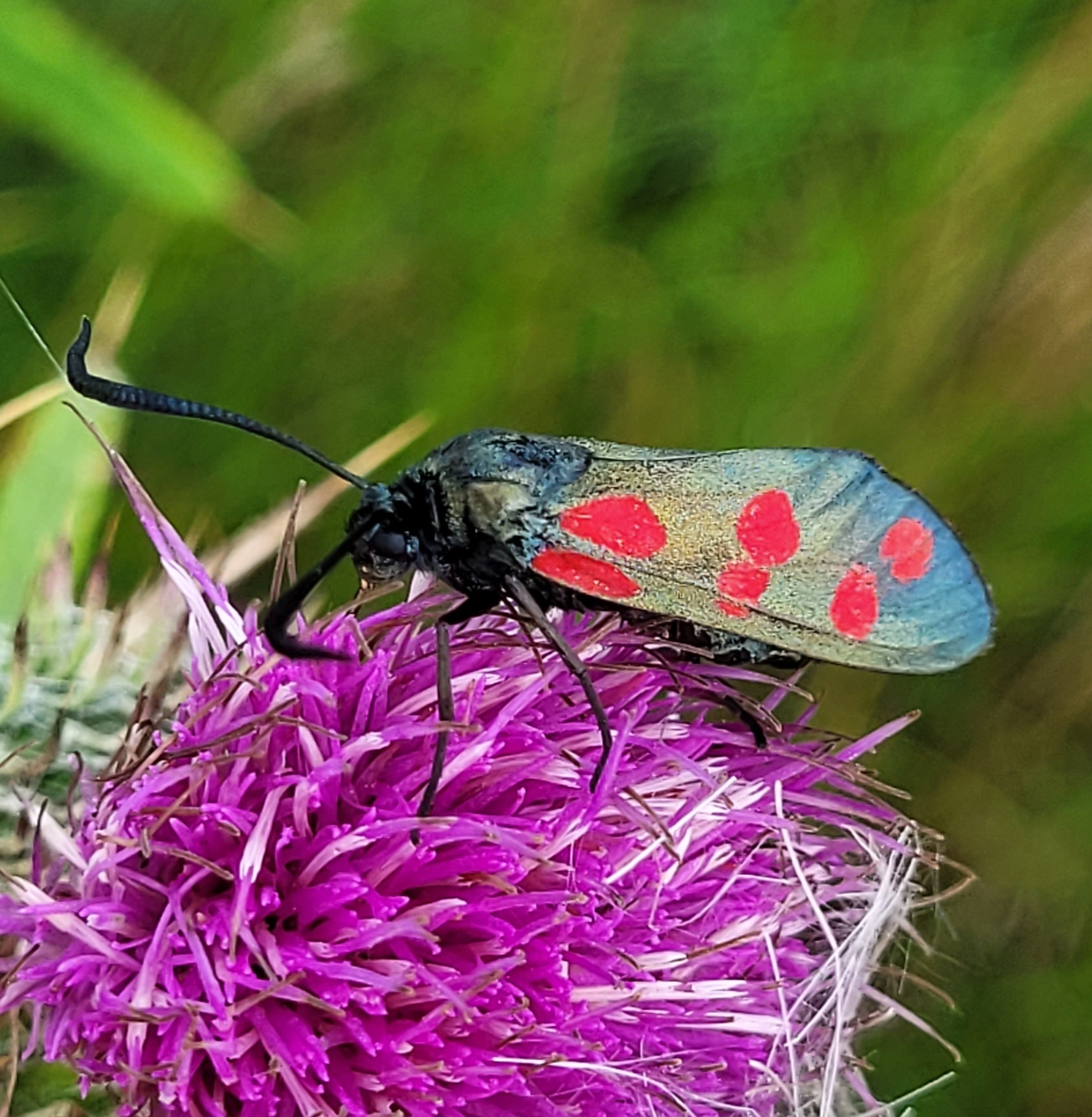
Six-spot burnet (Zygaena filipendulae) (Photo: Tim Butter)
Why do we run the Farmer Moth Monitoring Programme?
The Farmer Moth Monitoring Programme provides important data that supports the All-Ireland Pollinator Plan and helps provide an evidence-base for pollinator-friendly actions.
The detailed monitoring of moths also provides useful information relating to climate change. The distribution of some species has moved northwards over the past decades, while many species are flying earlier in the year than they did thirty or forty years ago. Most people are familiar with the life cycle of a butterfly, and moths have the same four stages (adult – egg – caterpillar – pupa – and adult again). However, some now undergo two complete life cycles every year when historically they may only have undergone one as warmer temperatures provide a longer season.
Overall, the Farmer Moth Monitoring Programme generates high quality data relating to moth populations on farmland, which is important from a scientific perspective. From the point of view of the participating farmers, the Farmer Moth Monitoring Programme has forged a new connection between those farmers and the biodiversity on their own farms. For many it has been an opportunity to learn more about the extraordinary diversity of life that mostly goes hidden from view.
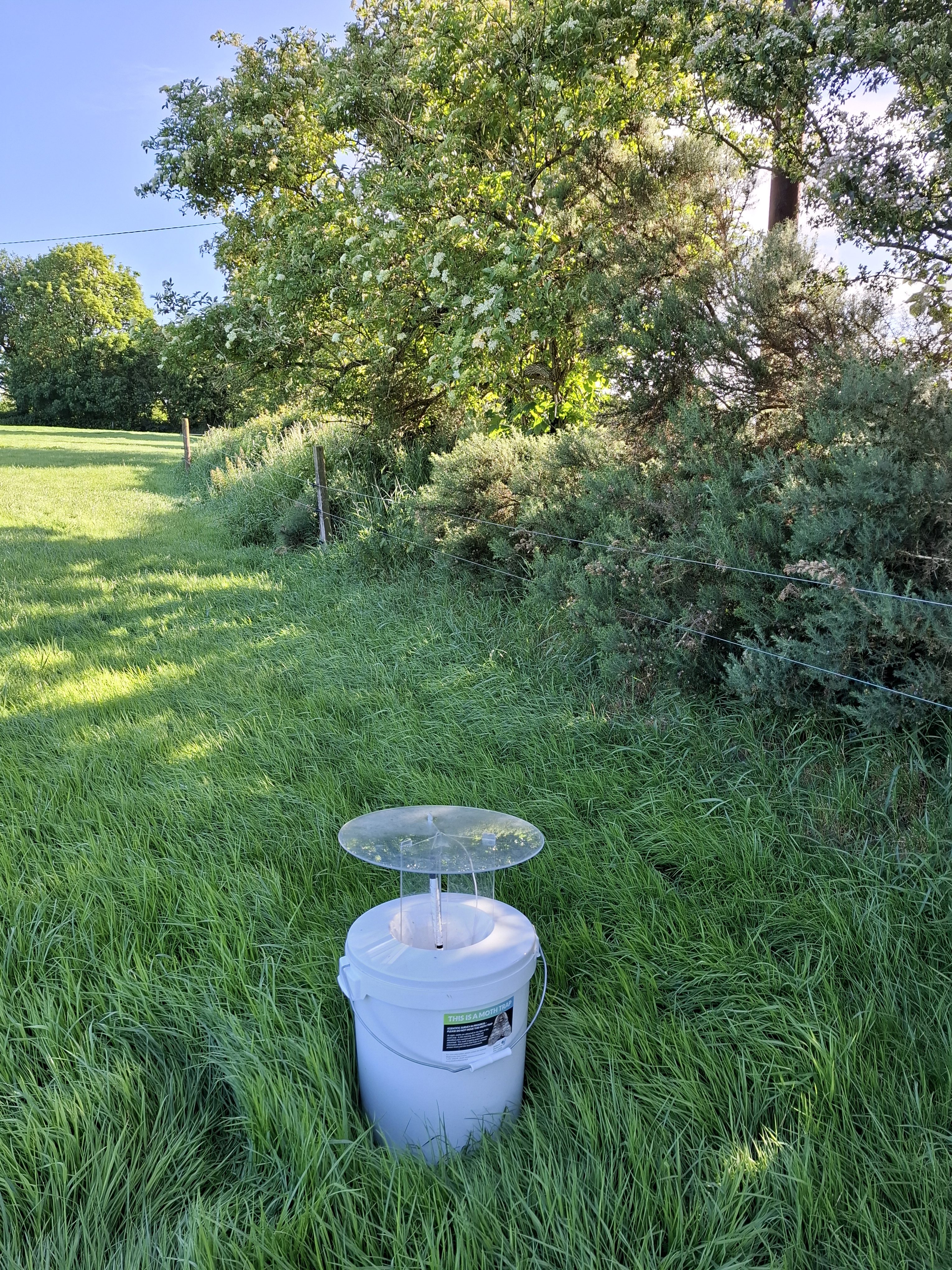
A moth trap used in the Farmer Moth Monitoring Programme (Photo: Tim Butter)
How does it work?
In 2025 there were 59 participating farmers, with farms located right across the Republic of Ireland and including all types of agricultural activity. Each farmer was issued with two low-cost battery-powered moth traps, equipped with LED lights with high output in the UV range. The traps are based around a bucket with a specially designed lid with a funnel built in to it. There are a set of three clear plastic upright fins that sit in the funnel and support the LEDs, with a rain cover over the top. At night, moths are attracted to the UV light and are guided by the upright fins down the funnel into the trap. Inside the trap are cardboard egg trays, and when the trap is inspected in the morning the moths will be resting, unharmed, on the cardboard.
A schedule of moth survey nights was established, running for one night every two weeks from mid-April to the end of September. Every farmer would put out the two traps on the survey night. The first trap was located in the middle of a field, which was chosen as a good representation of the agricultural activity taking place on the farm. The second trap was placed next to a hedge in the same field.
In the morning, the traps were emptied, all the moths were photographed and then released unharmed. The photos were then forwarded to the NBDC for expert identification and enumeration.
The method is very simple: it doesn’t require experts present at the survey site; it is very reproducible from site to site, and it reduces skew and bias in surveying.
It is important to note that in the Republic of Ireland it is necessary to have a licence from the National Parks and Wildlife Service to run a light trap for moths. All of the farmers participating in the Farmer Moth Monitoring Programme were covered by a project licence held by the National Biodiversity Data Centre.
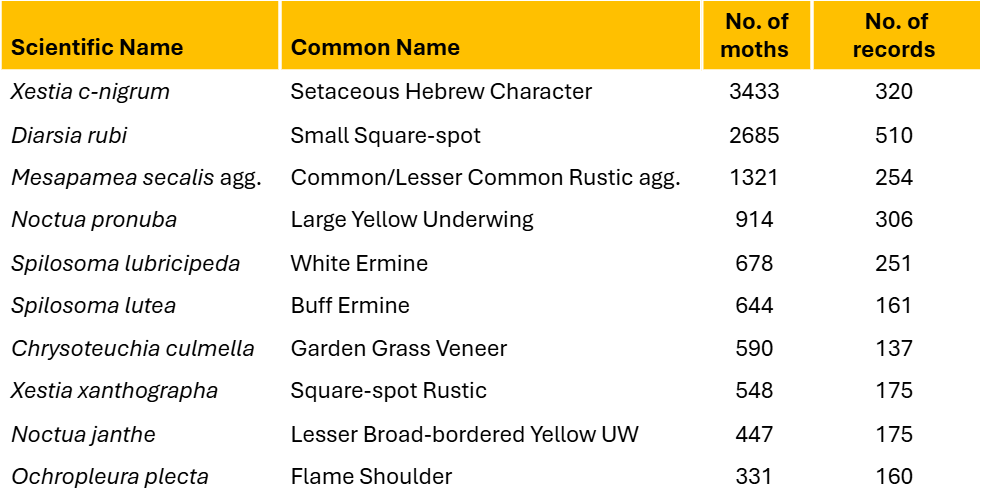
Data from the 2025 Farmland Moth Monitoring Programme: Note: Common Rustic and Lesser Common Rustic cannot be reliably separated from each other by visual examination, so they are recorded as an aggregate (agg,) of the two species.
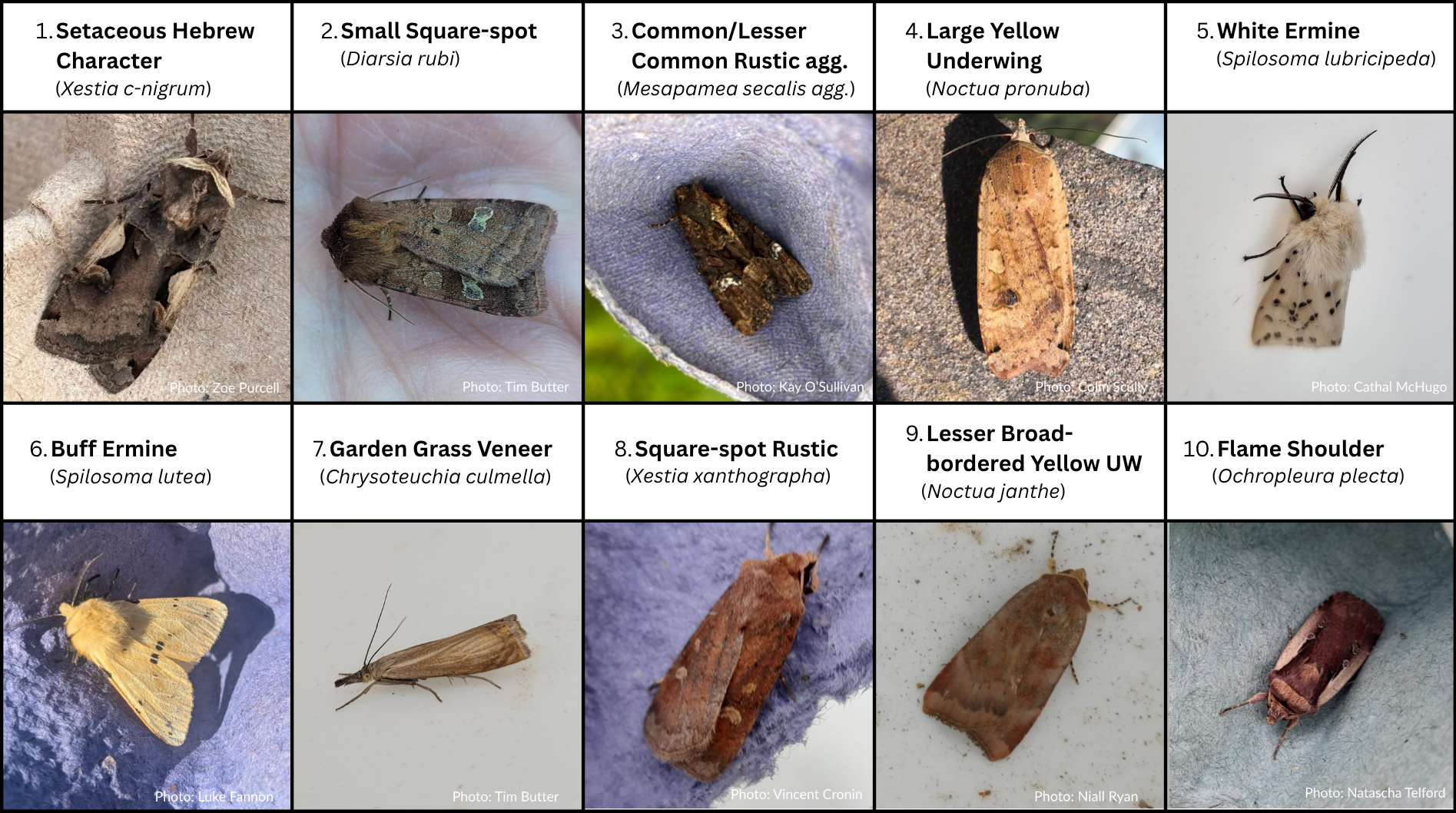
The ten most frequently recorded moth species in 2025.
What happened in the first year?
The Farmer Moth Monitoring Programme enjoyed a very successful first year in 2025. The 59 participating farms all submitted data on the moth surveys every two weeks (minus periods of bad weather or vacations). Across the network of farms, and with every farm having two traps, over the 13 surveys this amounted to over 1400 survey nights. A total of 23,000 individual moths were reported, from 371 different species. The average farm recorded 70 species and 384 individual moths. The highest number of species recorded on a single farm was 102, and the highest number of individual moths recorded on one farm was 1142.
The bulk of the data set was the large number of records for the more common moth species. The ten most frequently recorded species are displayed in this table.
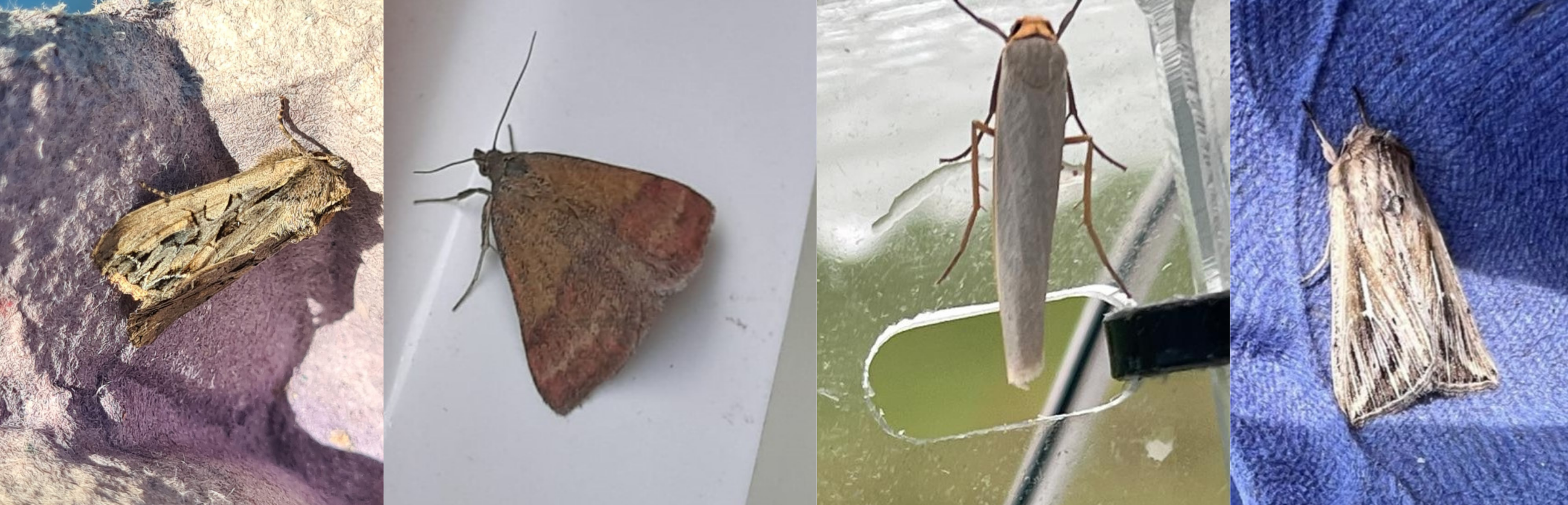
The less common moths recorded in 2025, from left to right: Dog’s Tooth (Sean Keane), Small Purple-barred (Vincent Cronin), Hoary Footman (Eimear O’Donnell), and L-album Wainscot (Eimear O’Donnell)
Rare moths in 2025
As well as the more common moths, a number of rarer moth species were recorded, including some Red List species such as Dog’s Tooth, Small Purple-barred, and Hoary Footman. Also recorded were some unusual migrant moths, including a Clifden Nonpareil near Limerick city and an L-album Wainscot on the Waterford coast. Many insects migrate to Ireland from continental Europe during the summer months, with the Painted Lady butterfly probably being the most well-known. However, lots of moth species also make this migration. Some come here every year, such as the Silver Y, while others are much more occasional visitors. The Clifden Nonpareil and L-album Wainscot are in the latter category with less than 30 Irish records to date for either species.
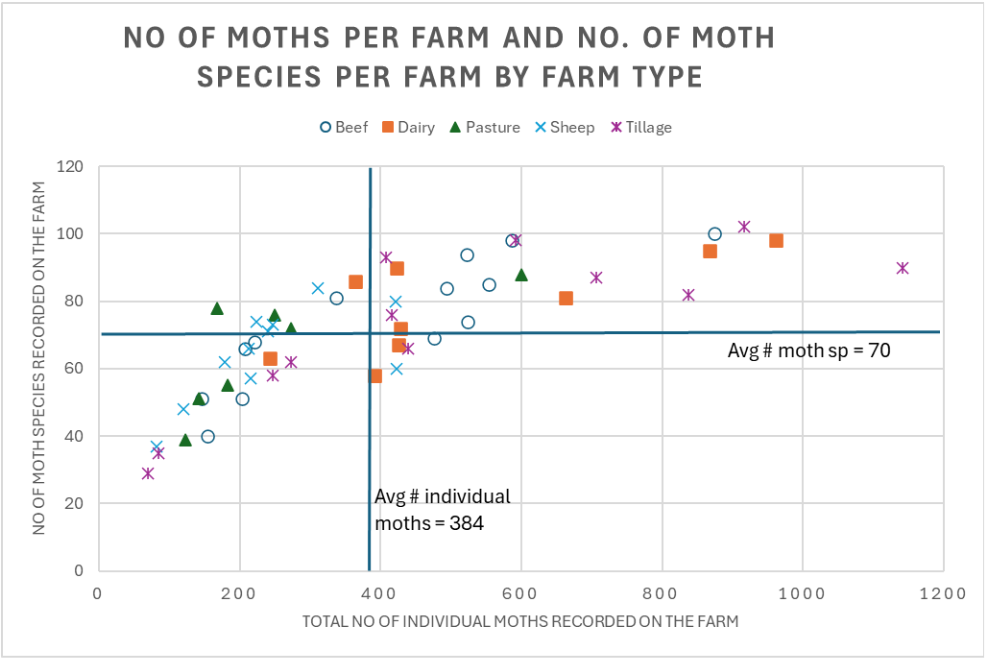
Moth diversity and farm activity
In general, the farms with the higher numbers of individual moths also had higher numbers of moth species, and vice-versa for farms with lower number of moths and moth species. In other words, farms with higher moth diversity also had more individual moths, and farms with lower moth diversity had lower numbers of individual moths. The graph also gives an indication of where each individual farm was positioned on this scale assessed against the main agricultural activity on the survey field.
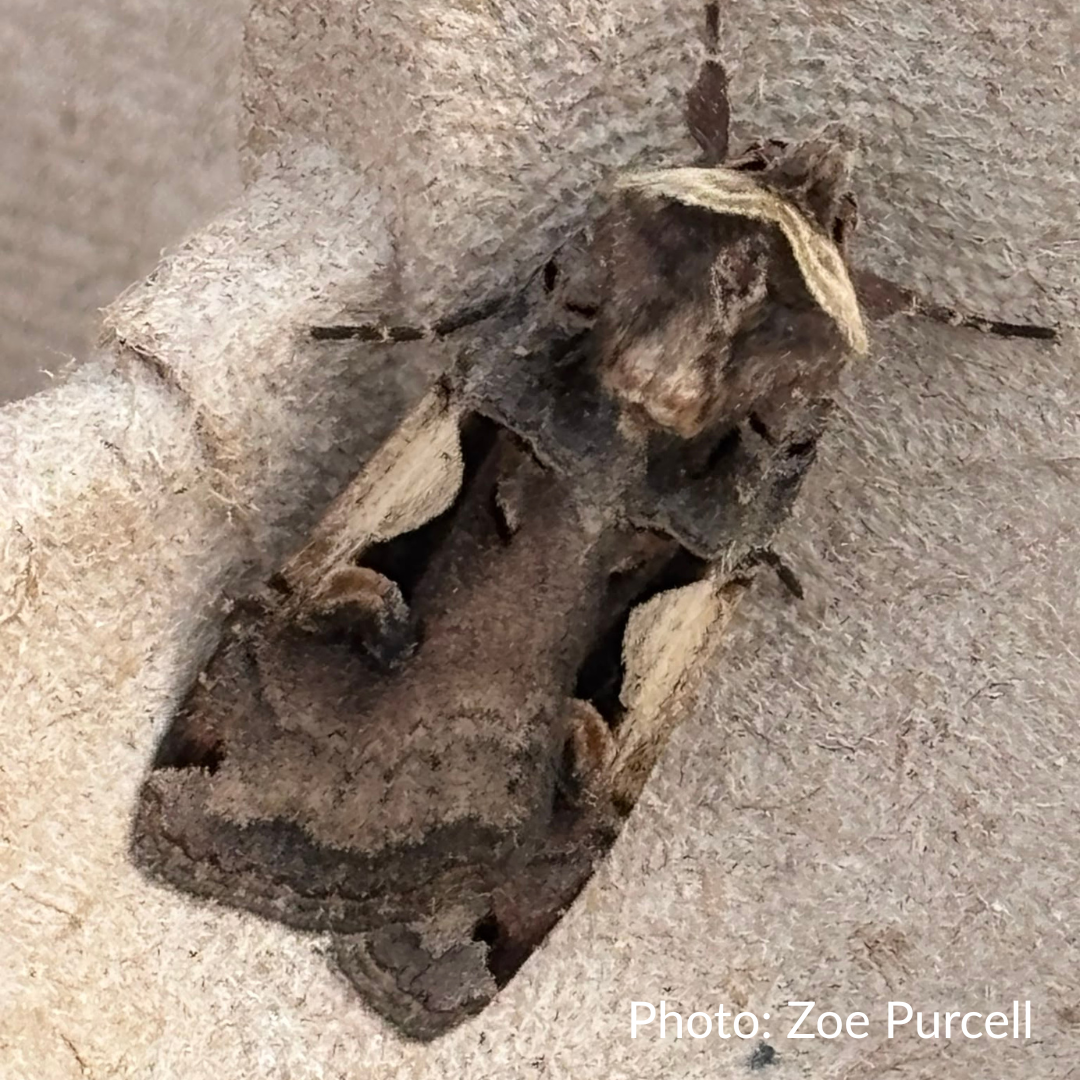
Setaceous Hebrew Character (Xestia c-nigrum) (Photo: Zoe Purcell), one of the most commonly recorded moths in the FMMP for 2025.
What did we learn in 2025?
There is too little data to draw any conclusions yet, but based on the 2025 data, lower numbers of moths were recorded on sheep farms and where grass is grown for harvesting for silage. Beef and dairy farms seem to have higher numbers of moths and generally higher moth diversity. Interestingly, tillage farms include those with both the highest and lowest moth diversity and highest and lowest number of individual moths, and all points in between.
It was noticeable that some of the tillage farms in the midlands, east and south recorded very high numbers of Setaceous Hebrew Character moths in a single night. One farm recorded 237 of these moths in one trap on one night, and a further three recorded over 100 Setaceous Hebrew Character moths in one trap on one night. As can be seen from the graph, there were quite a number of farms that recorded less than 237 moths of all species combined in total in the whole year!
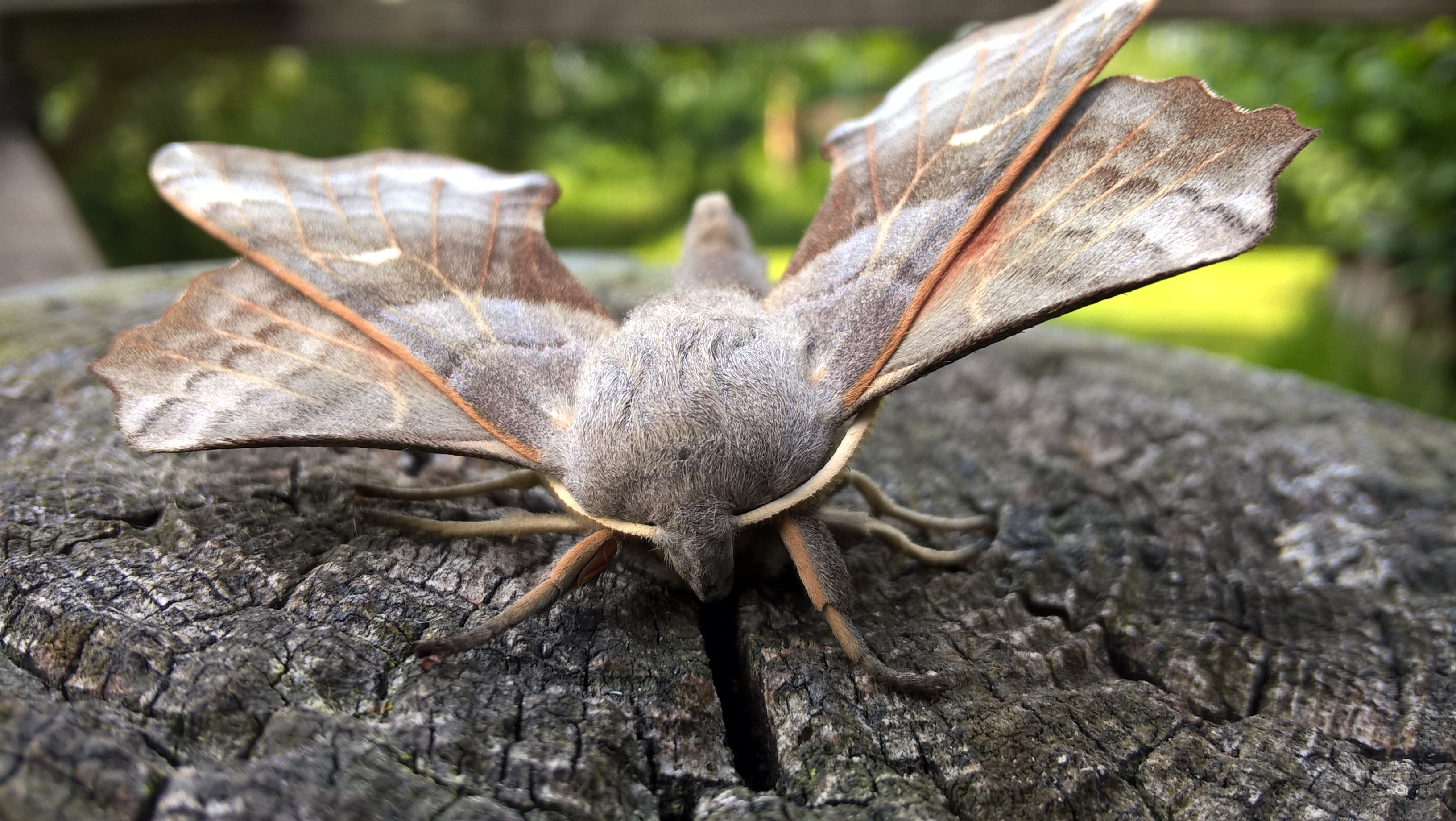
A Poplar Hawk-moth (Laothoe populi), a species recorded on almost every farm in 2025.
What was the farmers' response?
The National Biodiversity Data Centre obtained an excellent data set from the first year of moth surveys, and hopes to build on this over the coming years. But how have the participating farmers benefitted from the Farmer Moth Monitoring Programme?
Feedback from the farmers revealed that they found the project simple and fun, even though they were collecting serious scientific data. It established a connection between the farmer and the biodiversity on their own farm. A significant factor is that when the moths are photographed in the morning, they are quiet and at rest, so can be examined easily at close quarters. It is a rare opportunity to get close to a wild animal. And while many moths are quite small and brown, there are many very colourful species and also some surprisingly large types. Almost every farm recorded at least one Poplar Hawk-moth – a particularly large and beautifully patterned moth.
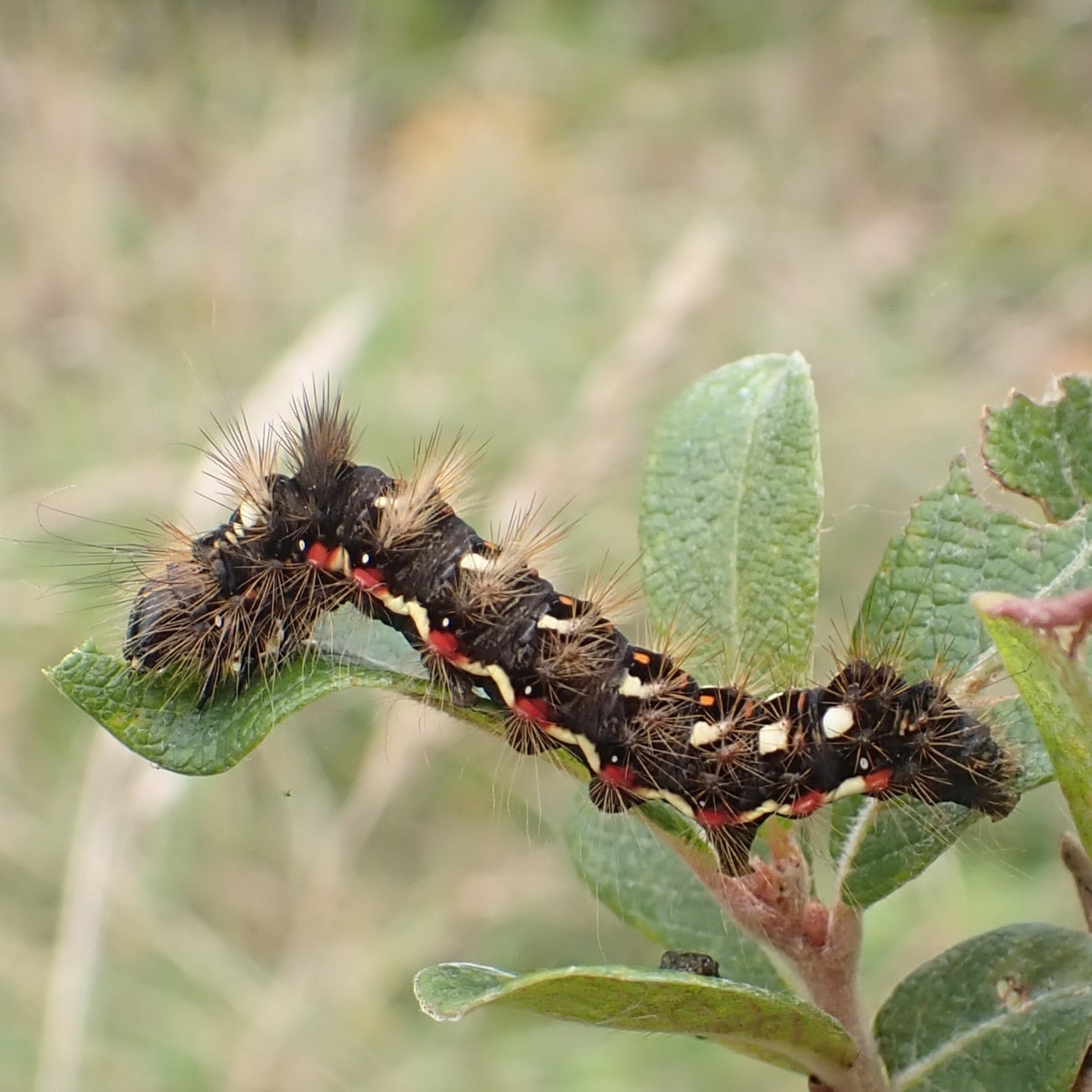
The caterpillar of the Knot Grass moth (Photo: Tim Butter)
What's next for the Farmer Moth Monitoring Programme?
For 2026 the scheme has expanded to almost 80 farms nationally. It is planned to increase this in stages over the next few years and eventually reach 100 farms. Currently we only have a snapshot of moth diversity on Irish farmland. To make the most of the dataset, it is important that the Farmer Moth Monitoring Programme becomes a long-term scheme. This will allow us to track changes in farm moth numbers and diversity over time and give insight into any changes in the distribution of moth species and their flight times.
The programme will continue to expand over the coming years, with farms chosen to ensure all types are represented and all geographic areas are covered. If you would like to put your farm forward for future consideration, please contact Tim at tbutter@biodiversityireland.ie
Top 5 tips for managing your land for moths
Moths can be encouraged by making small-scale changes. These are the top 5 actions you can take to make your land more moth-friendly:
- Try and plant or encourage the growth of native deciduous trees and shrubs. Many moth caterpillars use species such as Oak, Hazel, Willow, Alder, Ash, Elm, Hawthorn, Blackthorn and Birch. The catkins of willows and sallows are very important food sources for early season adult moths. These trees and shrubs are also great for attracting wildlife generally.
- Planting flowers which have evolved to produce nectar at night will help attract many moth species. Plants like Honeysuckle, Large-flowered Evening Primrose and Red or White Campion are good native plant choices.
- Aside from planting, letting any existing flowers grow is probably the best method. Native flowers such as Dandelion, Common Knapweed, Cuckooflower, Devil’s-bit Scabious and Red Clover often grow in verges and lawns, so not mowing as frequently gives them a chance to bloom and in turn provide moths with much-needed nectar. Ivy is a vital late-season nectar source for autumnal moth species.
- Sensitive management of hedgerows and verges will allow these plants listed above to thrive. Try and allow them to finish flowering before cutting and avoid cutting back too hard. Caterpillars often feed on the current or previous years’ growth.
- Minimise light pollution. Where possible turn off lights at night. If lights have to be left on, then use lights that are warm colours and avoid cold (blue) lights. Use shields and direct lighting to where it is needed and avoid pointing lights into the sky or above the horizontal level.
Canary-shouldered Thorn (Ennomos alniaria) (Photo: Tim Butter)
Common Emerald (Hemithea aestivaria) (Photo: Tim Butter)
Comments from the farmers
“Taking part in the moth monitoring scheme has given our family a greater appreciation of the biodiversity that exists on our farm. It’s rewarding to know that the data collected can inform nature conservation and sustainable farming practices for future generations.” – Vincent
“We are amazed at the diversity of moths that we are seeing in our moth traps. Every fortnight there are new species and we were really thrilled to get Emperor Moth a few weeks ago. It is incredible that all these beautiful creatures are flying around at night, and very few people know.” – Karina
“I had low enough expectations of the diversity in our pasture on joining the program. We are not organic, just an average small holding. I was pleasantly surprised with the variety of moth species we got in the first year, ID’ed and recorded with expert help and support from Tim in the NBDC. Now I’m eyeing up different parts of the land thinking – “What else is hiding here?”” – Sarah
“As a farmer, I really enjoy taking part in the Moth Monitoring Programme. It has opened my eyes to the secret life of pollinators on my farm that I was never aware of. The info that we are collecting is so beneficial to support how food production and nature can work side by side while highlighting the importance of protecting our biodiversity both now and into the future” – Elaine
“The moth surveys are invaluable in building up a baseline and tracking over time the variety and numbers of diverse species on my farm which is designated and widely considered to be species rich grassland, both calcaerous limestone and saltmarsh.” – Tom