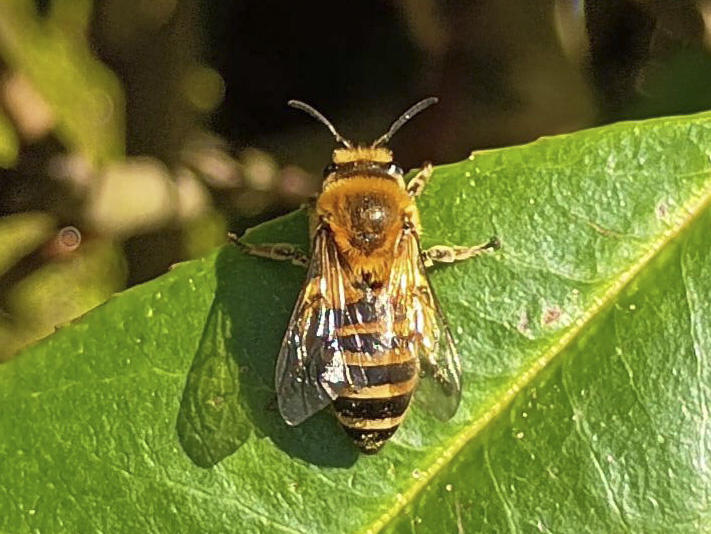
The Ivy Bee, first recorded in Ireland in 2021, has just been spotted in Sixmilebridge, Co. Clare.On September 26th, the Ivy Bee was recorded in Sixmilebridge by citizen scientist, Jim Oldroyd. Until now, the Ivy Bee has only been recorded in the south-east of Ireland, mainly along the Wexford coast.
The Ivy Bee was first spotted in October 2021, at the Raven Nature Reserve in Co. Wexford, by photographer and citizen scientist Jim Kenny. This first record showed it had expanded its range from Britain. Since then, there have been sightings elsewhere in Wexford and in Wicklow. Until Jim’s sighting, the most westerly record of the Ivy Bee in Ireland was from New Ross, Co. Wexford.
The Ivy Bee (Colletes hederae) nests in loose, light or sandy soil on southern-facing banks and cliffs with ivy nearby for nectar and pollen. They are most active in September and October when Ivy is in flower. In Britain, they are common in urban and farmland settings, as well as coastal heathlands. They are solitary bees, but when conditions are suitable, there may be thousands of nests in the same area. Like most wild bees in Ireland, they are not aggressive and are not a threat to humans.
In Ireland, we have 80 solitary bee species, 21 bumblebee species and one honey bee. Unfortunately, pollinators are in decline, largely due to a loss of suitable habitat that provides them with food and shelter. The recently-launched All-Ireland Pollinator Plan 2026-2030 aims to reverse pollinator declines by bringing together different sectors to create pockets of habitat every 200 metres.
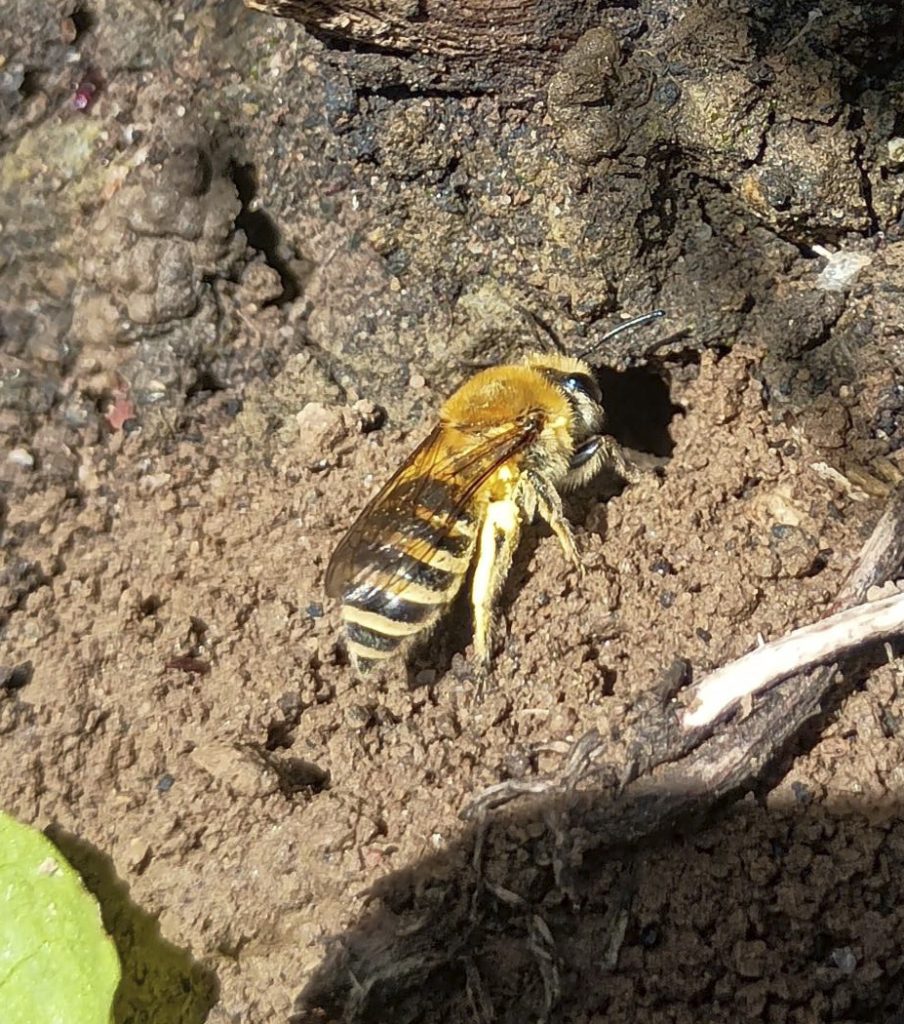
Jim Oldroyd, who discovered the bee in Sixmilebridge, said: “I spotted the colony whilst out walking with my children, Sloane and Jude. Having an interest in the natural world, I’m always on the lookout for something interesting. The first thing that drew my attention was the noise the bees were making digging burrows. The earth was shooting out like a miniature volcano! When I saw the bee, I knew I was looking at something unusual, and I was delighted when I got confirmation it was the Ivy Bee. It’s a beautiful looking creature with a fascinating life cycle.
“The colony is very active, it’s intriguing to watch the females clearing out the burrows in such an accessible place for people to see, right on the edge of a housing estate. The bees don’t seem to mind being close to humans, in fact they show no interest at all. I hope the residents of Sixmilebridge get the chance to enjoy the colony as much as I do! It just goes to show the importance of allowing space for wildlife to thrive and not being too tidy. In this case, all nature needed was a bare slope and some flowering ivy. I’m not quite sure how the Ivy bee came to Sixmilebridge, but I’m glad it did. Fingers crossed the pupae survive the winter and hatch to enjoy the ivy again.”
Barry O’Loughlin, Clare County Council Biodiversity Officer, said: “This is a significant find and a new record of this solitary bee for County Clare. Communities across Co. Clare are embarking on pollinator-friendly initiatives to conserve declining bumblebee and solitary bee populations. This new record highlights the importance of partnering with the All-Ireland Pollinator Plan and submitting records to the National Biodiversity Data Centre.”
According to Owen Beckett, National Biodiversity Data Centre: “This new record represents a surprising expansion of the Ivy Bee’s range in Ireland. It suggests that the species might be much more widespread than previously thought, especially in the southern counties. It is a timely reminder of the significant role that citizen science plays in allowing experts to track distribution and population changes of our pollinating insects”
The National Biodiversity Data Centre encourages everyone to send in suspected sightings of the Ivy Bee, to help track pollinator numbers. Visit our Recording System : Solitary bees
EDITOR’S NOTES:
About the All-Ireland Pollinator Plan
The All-Ireland Pollinator Plan is a framework bringing together different sectors across the island of Ireland to create a landscape where pollinators can survive and thrive. It is managed by the National Biodiversity Data Centre.
One-third of our wild bee species is threatened with extinction. This is mainly because we have drastically reduced the amount of food and safe nesting sites that support them. To help tackle this issue, the All-Ireland Pollinator Plan was established in 2015. Working with local authorities, businesses, farmers, communities, schools, sports clubs, and gardeners, it provides a clear roadmap for managing our landscape to support pollinating insects. It is a shared plan of action: together, we can take steps to restore pollinator populations to healthy levels.
More information: pollinators.ie
Range Expansion Vs. Invasive species Distinction
The arrival or spread of a new species does not necessarily mean that it is an invasive species or brings problems. Wildlife naturally changes its distribution over time, and some species are extending their ranges as climatic conditions change. The Ivy Bee has naturally spread northwards through Europe in recent decades and is not currently considered a threat to Ireland’s native pollinators. This is very different from an invasive non-native species, whose introduction and spread can cause harm to native wildlife, habitats or ecosystems. Recording species such as the Ivy Bee helps scientists track these changes and understand how Ireland’s biodiversity is responding to a changing environment.
Solitary Bees
- 95% of the world’s 20,000 bee species are solitary rather than social bees.
- Solitary bees do not form colonies with a queen and workers, like social bumblebees or honeybees. Each female makes her own small nest. Within each cell, she lays a fertilised egg and leaves a food reserve composed of regurgitated nectar and pollen. The larvae feed on the provisioned food before pupating and spending the winter hibernating to emerge as adults the next year.
- Solitary bees look very different from bumblebees. They are much smaller and occur in a range of different shapes and colours. Some species are small and black like ants with wings, while others have black and yellow striped bodies like wasps.
- Irish solitary species nest in various different ways. Leafcutter solitary bees cut circular pieces out of leaves with their teeth and carry them back to line their nests, often in hollowed out twigs or bamboo canes. Mining solitary bees make their nests by digging holes in the ground. One solitary species called (Osmia aurulenta) lives in sand dunes and will only nest in empty snail shells!
To find out more about our solitary bees, visit Pollinator Plan: Solitary Bees
About the National Biodiversity Data Centre:
The National Biodiversity Data Centre works to make biodiversity data and information more freely available in order to better understand and assist the protection of Ireland’s biodiversity. To find out more about our work, please visit biodiversityireland.ie
CONTACT:
Interviews are available – with Owen Beckett, National Insect Database Officer, National Biodiversity Data Centre.
Email: obeckett@biodiversityireland.ie
Juanita Browne, Communications Officer National Biodiversity Data Centre
Email: jbrowne@biodiversityireland.ie
Tel. 086-1959073