
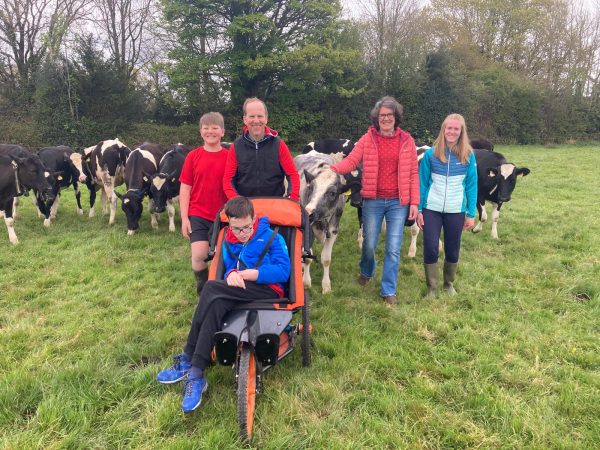
My name is Cheryl, and together with my husband Alan, and our three children, Jacob, Isabelle and Danny, we farm on 103 acres just outside of Gorey, in north County Wexford. We typically milk 72 cows, and we rear our own replacements.
This farm has been in Alan’s family for well over 300 years. We feel very privileged to have the stewardship of this piece of land at this time, when taking action to look after our biodiversity, our water quality and our climate, is so important. We also need to be very mindful that agriculture is massively important to the Irish economy. So, with all this in mind, over the years since we took over here, we have strived to bring nature back to front and centre. We wanted to show that farming and nature can go hand in hand, and indeed they need to. As we developed the farm to streamline the operation, we have been able to give more time and space to nature. We have a developed a high EBI (Economic Breeding Index) herd, producing high milk solids, with low SCC (Somatic Cell Count) and our farm enterprise has a high NUE (Nitrogen Use Efficiency). We also currently have 20% of space for nature. We have a few conservation projects going on and a whole lot more in the pipeline.
We are especially proud of our farm’s mature hedgerows. Since we took over about 16 years ago, we have managed our hedgerows on a three-year rotation. This means that every three years, a third of them are trimmed back, only on the sides. We only trim the tops where necessary, such as under power lines. By doing this we have seen huge development in the hedgerows. Plants are allowed to grow and develop, they produce flowers which yield fruit and seeds. This in turn provides food for pollinators, insects, birds and mammals. It is amazing now to walk along the cow road, listening and watching for insects and birds – there is so much life in them now. We have several boundaries where we leave 2 metre margins between the hedgerow and the grazing area. These are turning into fabulous habitats featuring tussocky grass and many plant species. The big hedgerows are also a great habitat for nighttime pollinators such as moths. We are involved in a new Farm Moth Monitoring project and do also conduct regular bat surveys. We have been doing the annual national Daubentons Bat survey on the river for over 20 years.

The gorse is always the first to flower as the elder leaves start to unfurl, then we have the Whitethorn flowering. It always looks almost ghostly in the dawn and dusk, and as we go about our work at these times, in the age-old ways of farming, I wonder how many stories and myths through the ages have been built around these ghostly looking shapes in the ditches.
Last year (2024) we planted about 600m of new hedgerow. This was pruned back during February and it is now starting to grow well, it feels weird to prune back hard, but already we can see the benefit, as instead of one leader there are 4 or 5 on each plant.
We spotted our first bumblebee, a Buff-tailed queen, on the 25th February. Since then, they are getting more and more plentiful. I feel that there are definitely more than last year. I have been watching out for and recording as many pollinators as I can, and trying different means of identifying them.
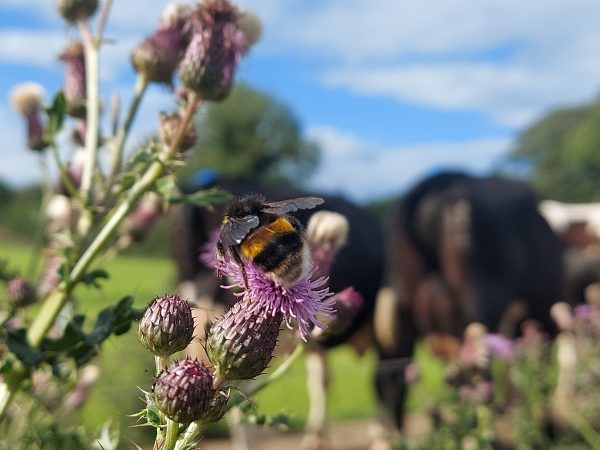
We recently had a school group visit from Gorey Educate Together Secondary School, and the pollinators put on a great show for them. It is great to get the opportunity to explain about all the different types of pollinators and how important they all are. We also had a look at the river and did some kick samples to assess river water quality, in a citizen science project run by LawPro.

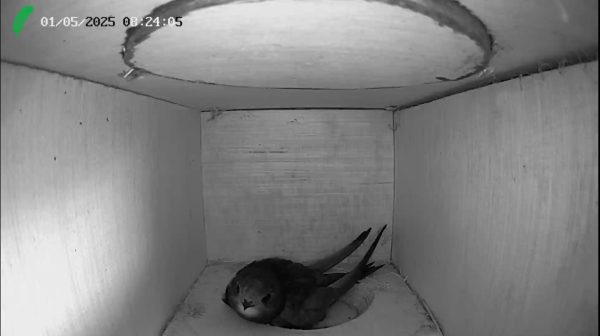
One thing I love to do is to have my Merlin app running as I walk alongside the ditches, as the birds are in full song at the minute. We have so many different species, including the likes of Robin, Sparrow, Chiffchaff, Wren, Chaffinch, Greenfinch and Willow Warbler. We also have the Buzzard song to listen to and we are more regularly starting to see a Red Kite overhead. Also on the river we have Kingfisher, Dippers and Herons. Our first Swallow returned in the last couple of days of March, we only spotted two on the 30th and 31st March, and about a week later a few more arrived. The first Sand Martins were spotted on 24th March and within a week the Sand Martin wall was buzzing with activity. It’s amazing to think of these tiny creatures making their massive journey to sub-Saharan Africa and back. Our first Swift arrived back on 30th April, this is quite early for them, they are usually the last to arrive and the first to leave.
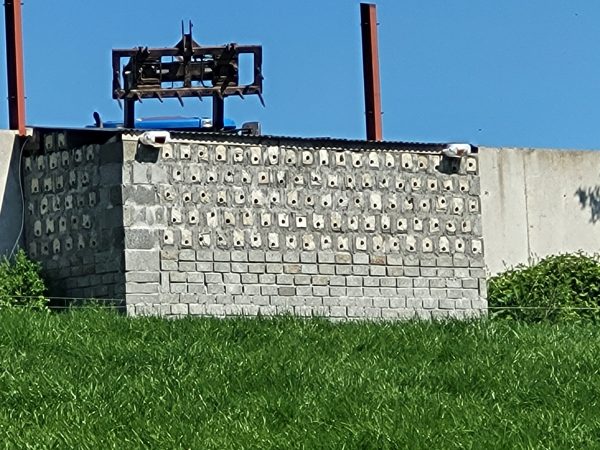
The Sand Martin wall is shown in the photo, it is made with cavity blocks. In 2023 a colony made a home in our neighbours’ farm, where they had temporarily exposed a sand bank. We decided to build a Sand Martin wall to give them a nesting option going forward. We were rewarded with 28 out of the 124 nest cavities being occupied in the first year (2024). We were delighted to see one that was tagged originally in 2023, making a home in the new wall last spring. It was re-caught when we were tagging in 2024.
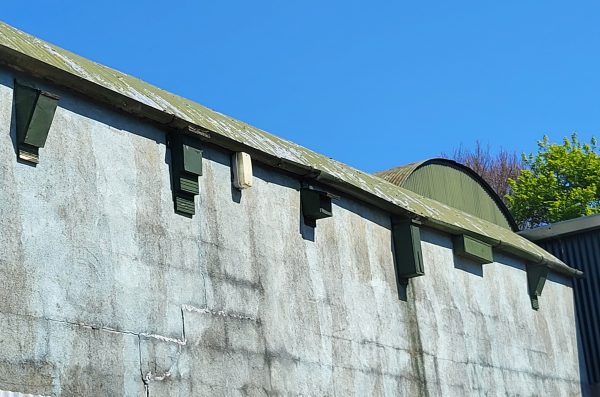
To mark the 1st of April this year and the start of a new quarter of the year, we planted another 30 trees. This formed a wildlife corridor from where our bat houses are to the existing hedgerow. We plan to develop our bat colony, by providing various types of accommodation Wildlife corridors are so important for them, and valuable for so many creatures. Bat houses come in different shapes and sizes and often people think they are bird boxes, but they typically have an entrance in the bottom that the bats crawl up into. In the photo you can see an array of different types of bat boxes.
I could talk all day but I will sign off now. We are full of ideas and plans for the future. Every little thing that you do is another little thing that helps. Our motto here is: “Real. Positive. Change.” You have to be real about what needs to be done, and what you can do. You have to stay positive and move forward positively. We all have to make change happen. We need to think biodiversity, in everything. We can all make a difference.
We can be contacted on ballyowenbioschool@gmail.com
Follow the Festival of Farmland Biodiversity during the month of May, to celebrate #farmlandbiodiversity.
