2026 marks the National Biodiversity Data Centre’s 20th year working to improve our understanding of Ireland’s biodiversity and support its conservation. This milestone year is an opportunity to highlight some of the Centre’s achievements over the past two decades.
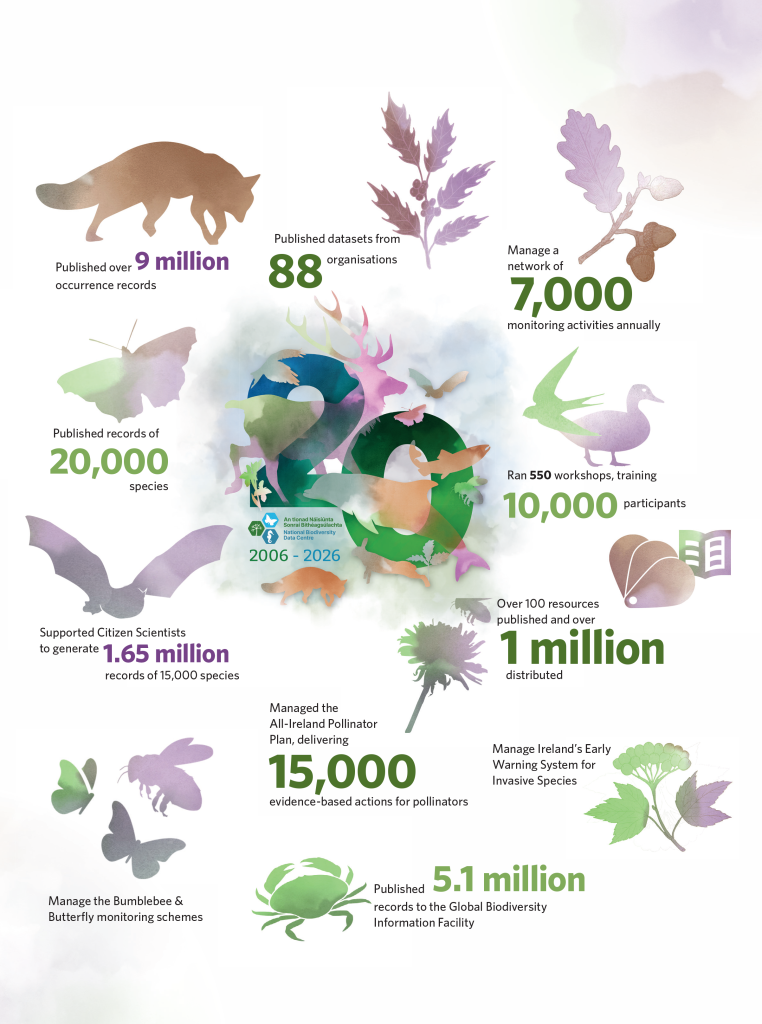
The Centre provides Ireland’s Citizen Science Portal, where anyone can log their wildlife records, and has published more than 9 million occurrence records of almost 20,000 species. This includes over 3.8 million records of protected or threatened species. Much of this data comes from the public or ‘citizen scientists’ who want to contribute to conservation by participating in the Centre’s monitoring schemes on butterflies, bumblebees, dragonflies, moths, rare plant populations and marine biodiversity. The Centre supports a network of 30,000 recorders.
The citizen science programme, Explore Your Shore! has greatly improved our understanding of our marine and coastal biodiversity, generating almost 40,000 records of over 900 species around our coast. The Butterfly Monitoring Scheme has tracked trends in 15 of our commonest butterflies over the past 18 years, highlighting declines in once-common butterflies such as the Green-veined White, which has suffered a massive decline of 84%.
The Centre’s Bumblebee Monitoring Scheme began in 2012, making it one of the first schemes of its kind globally. It has revealed declines in common bumblebees across the island of Ireland, showing year-on-year declines since monitoring began, with one-third of our 100 wild bee species at risk of extinction.
A significant contribution to Ireland’s biodiversity knowledge base has been the development of the data and mapping portal, Biodiversity Maps. Biodiversity Maps provides free and easy access to biodiversity data and datasets managed by partner organisations. It is a valuable resource for ecologists, researchers and decision-makers to improve the quality of decisions for conservation, and for citizen scientists and local communities to better understand the biodiversity of their locality.
“Supporting like-minded people who have a passion for biodiversity has been one of the most rewarding parts of our work.
We are extremely grateful to all of our partner organisations and funding bodies, to the NGOs who have shared their data, and to all of the 30,000 volunteers who have submitted records.
We look forward to many years’ working with this growing network.” – Dr Liam Lysaght, CEO, National Biodiversity Data Centre
Data driving action
Not only is the Biodiversity Centre tracking population trends, but it also identifies and delivers evidence-based actions. For the past decade, the Centre has managed the hugely successful and internationally renowned All-Ireland Pollinator Plan, which has so far delivered 15,000 evidence-based actions for pollinators, building partnerships with about 100 organisations, 360 businesses, and all 42 councils across the island of Ireland in order to create or restore habitats where pollinators can survive and thrive. A state-of-the-art ICT system has been developed to track Actions for Pollinators across the island.
The Centre has also led the way on data on Invasive Species – one of the greatest threats to Irish habitats and biodiversity – mapping around 100,000 records. Invasive species are plants or animals whose introduction by human action occurs outside their natural distribution and they become invasive, threatening native biodiversity, food security, and human health and wellbeing. By establishing an Invasive Species Unit, the Centre has taken steps to curtail the incursion of new species, such as Asian Hornet, into Ireland and to help in the control of damaging species such as Japanese Knotweed. The Centre developed Ireland’s Invasive Species Alerts System and provides support for the Rapid Response model.
Supporting policy at home and abroad
The National Biodiversity Data Centre is responsible for 12 Actions in Ireland’s National Biodiversity Action Plan 2024-2030 and has developed an Action Tracker to support its implementation. The Centre also supports the National Parks and Wildlife Service (NPWS) to report under the EU Nature Restoration Plan and EU Habitats Directive.
The National Biodiversity Data Centre serves as Ireland’s Node of the Global Biodiversity Information Facility (GBIF) and the Centre’s CEO has served as Chair of GBIF for the past four years. The Centre has published over 4.9 million Irish biodiversity records, as well as data from Irish researchers about 132 different countries, to GBIF’s data portal, ensuring that Irish data contributes to building knowledge of global biodiversity as a resource for international research and policy development. Biodiversity Centre staff sit on various international committees, including the IUCN Citizen Science Task Force; the IUCN Species Survival Commission; the European Citizen Science Association; and the European Pollinator Initiative.
Training
Since 2006, the Biodiversity Centre has offered training for both professionals and amateur naturalists, running 550 workshops, training 10,000 people. In the past few years, the Centre has also developed free online courses, opening more opportunities to learn more about biodiversity and positive actions anyone can take to make sites biodiversity-friendly.
The National Biodiversity Data Centre promotes biodiversity by publishing guides, Atlases and identification swatches and posters, and have distributed over 1 million resources, with many more being distributed by local authority Biodiversity Officers. Countless more people have accessed these free publications online, creating much greater awareness and understanding of our biodiversity and actions towards its conservation.
Share this STORYMAP to allow others to explore the National Biodiversity Data Centre’s impacts over the past 20 years

—– INSERT PHOTOS FROM FORUM (HOLDING BIODIVERSITY IRELAND/PHOTO PROPS) ——-
CONTACT: Juanita Browne, Communications Officer jbrowne@biodiversityireland.ie
Interviews are available: PHONE 086-1955073