
Blessington, Wicklow, Ireland – 12 July 2024 – Citizen scientist and entomologist Brian Murray, in collaboration with the National Biodiversity Data Centre (NBDC), is excited to announce that a new, very large species of harvestman, Leiobunum species A (Leiobunum
sp. A), has been formally identified as a resident of Ireland for the first time.
Harvestmen are members of the order of Arachnids, but they are not spiders. They have neither fangs nor venom, and as such, they are completely harmless to humans. In December 2023, Brian Murray saw a photograph on the Facebook group ‘Insects and Invertebrates of Ireland’ taken on the grounds of the Curragh Camp in Co. Kildare, which, while it ultimately went unidentified at the time, led him to investigate further. “I knew there was something special about the picture,” said Brian, “I had been studying harvestmen myself for some time then, and it was unlike any native harvestman I had seen.” Thanks to the Irish Defense Forces, he gained access to the Curragh Camp in June 2024 and searched for a specimen. During his investigation, he found numerous aggregations of juvenile harvestmen. Although identification was initially impossible due to their juvenile state, he took several larger specimens home to rear them.
-
![]()
- Leiobunum sp. A (Brian Murray)
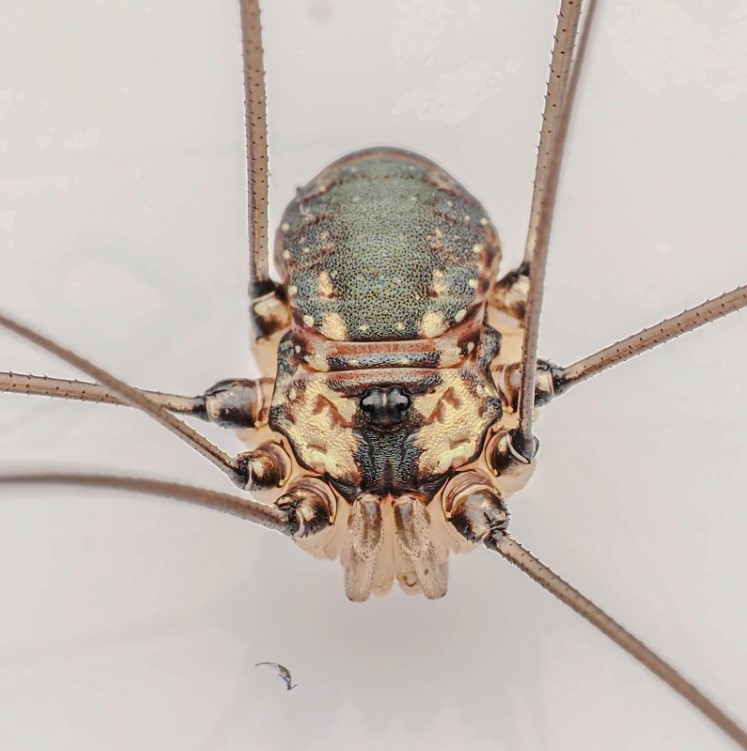
“This species sheds its skin (moults) up to ten times before reaching adulthood,” added Brian, “but eventually, they take on a characteristic metallic dark-green colour that is unmistakable and unlike any native harvestman. Their leg span is also considerably larger than any native species, as much as 6 to 7 inches.” The specimens are now mature enough for proper identification, and Brian has confirmed the species as Leiobunum sp. A. This was further validated by Hay Wijnhoven, the original discoverer of the species, using photographic evidence.
Leiobunum sp. A has a fascinating history and was first discovered in the Netherlands in 2004. Since then, it has been found elsewhere in Europe and has been recorded in Germany, Austria, Switzerland, Poland, and the UK. This species is typically found around houses, on walls, under window sills, and gutters. Its social nature leads to impressive social aggregations of fifty to a thousand individuals, often on the outside of buildings and similar structures.
Its unusual name comes about because, although it was first found in the Netherlands, its original country of origin remained a mystery until very recently. Scientists were waiting to discover this before it could be officially described and named as a species new to science.
-
![]()
- Close-up of Leiobunum sp. A (Brian Murray)

-
![]()
- Leiobunum sp. A (Brian Murray)

“The general public’s involvement as amateur entomologists, zoologists, botanists, and other specialists can significantly enhance the discovery and documentation of new species in the country and our overall understanding of the state of Ireland’s biodiversity”, said Owen Beckett, Insect Officer for the National Biodiversity Data Centre. “To encourage this, we have recently created our Biodiversity Learning Platform (https://learn.biodiversityireland.ie/), where users can enroll in free online courses. We would also ask the public to keep an eye out for this remarkable harvestman and report any sightings to the NBDC.”
Brian Murray, also known as @BeesOfIreland (Bees & Wasps of Ireland) on Twitter/X, is the founder of the microWild project (www.microwild.org), a native wildflower meadow and invertebrate reserve in Blessington, Wicklow. This is his second discovery of a new species in Ireland, the first being a species of potter wasp, Euodynerus dantici, in 2021. The National Biodiversity Data Centre works to make biodiversity data and information more freely available to understand better and assist the protection of Ireland’s biodiversity.
The NBDC has also produced a comprehensive guide to recording biodiversity: https://biodiversityireland.ie/app/uploads/2021/08/NBDC-Beginners-Guide-to-Recording-2022-WEB.pdf
**Key Points:**
1. A new species of harvestman has been discovered in Ireland.
2. Brian Murray was the discoverer, known as @BeesOfIreland on Twitter/X and
founder of the microWild project.
3. This discovery underscores the effectiveness and benefits of Citizen Science in
biodiversity research, marking Brian’s second new species discovery for Ireland.
4. The National Biodiversity Data Centre strongly encourages and supports citizen
scientists by providing many resources, including an online learning platform.
For more information, please contact:
Brian Murray: 087 243 5594 – bees@duck.com
National Biodiversity Data Centre:
Phone: +353 51 306 240
Email: info@biodiversityireland.ie
Web: biodiversityireland.ie
-
![]()
- Leiobunum sp. A (Brian Murray)
