• About Us
  • Conservation
  • Monitoring
  • Online Courses
  • Workshops
  • Publications
  • Shop
Menu
  • About Us
  • Conservation
  • Monitoring
  • Online Courses
  • Workshops
  • Publications
  • Shop

GL1E Juncus acutiflorus – Rhytidiadelphus squarrosus  grassland


  • Grasslands (GL)
  • GL1 Juncus acutiflorus – Molinia caerulea group
  • GL1E Juncus acutiflorus – Rhytidiadelphus squarrosus  grassland
Scientific name:
Juncus acutiflorus – Rhytidiadelphus squarrosus  grassland
Common name:
Sharp-flowered Rush – Springy Turf-moss grassland
Community code:
GL1E
Full PDF Synopsis
GL1E map: Juncus acutiflorus – Rhytidiadelphus squarrosus grassland
GL1E: Juncus acutiflorus – Rhytidiadelphus squarrosus grassland

Vegetation

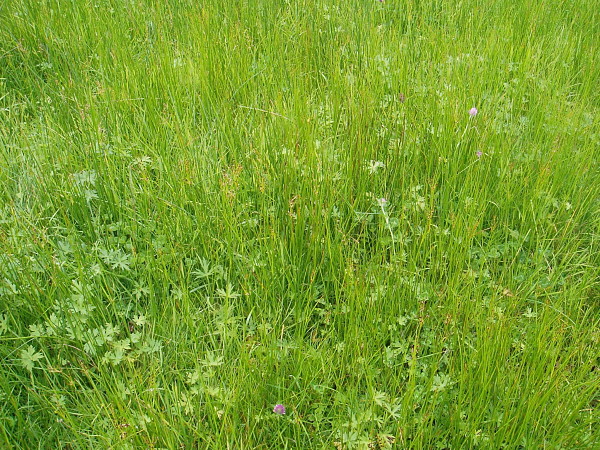
The sward of this wet grassland community is comprised mainly of Holcus lanatus, Juncus acutiflorus, Anthoxanthum odoratum, Juncus effusus and Cynosurus cristatus (mean graminoid height = 34.4 cm, n = 137). The forb component is low growing (mean forb height = 14.5 cm, n = 137) and consists mostly of Trifolium repens, Prunella vulgaris, Ranunculus acris, R. repens and R. flammula, with Cardamine pratensis, Galium palustre, Plantago lanceolata and Cirsium palustre also frequent. The bryophyte layer is quite distinctive, with Rhytidiadelphus squarrosus being abundant and sometimes forming a carpet with Calliergonella cuspidata and Brachythecium rutabulum.

Ecology

The Juncus acutiflorus – Rhytidiadelphus squarrosus grassland is found on wet, rather acidic peaty gleys (mean organic content = 30.5%, n = 137) of rather low fertility. It is a lowland farmland community of sloping ground (mean altitude = 99 m, n = 137; mean slope = 4.6°, n = 137).

Sub-communities

No sub-communities are currently described for this community.

Similar communities

This grassland is more species-rich and less rank than the other main Juncus acutiflorus sward, community GL1A, and also differs in that small sedges are more frequent in the present community, mainly Carex nigra, C. panicea and C. leporina. It differs from the similar GL4D Agrostis canina/vinealis – Rhytidiadelphus squarrosus, in that indicators of upland dry-humid grassland, such as Potentilla erecta, Hylocomium splendens and Luzula multiflora, are less frequent, whilst marsh plants such as Galium palustre, Cardamine pratensis, Ranunculus flammula and Ranunculus repens are more frequent.

Conservation value

This is a fairly species-rich grassland community (species/4 m2 = 28.2, n = 160) of which a low proportion of examples correspond with EU HD Annex I habitat 6410 Molinia meadows.

Management

These swards are managed as rough grazing land (typically for cattle). The main threats to these grasslands include improvement, abandonment and afforestation.

  • Contact Us
  • 051 306 240
  • National Biodiversity Data Centre
    Beechfield House,
    South East Technological University West Campus,
    Carriganore,
    Co. Waterford,
    Ireland.
    X91 PE03


The National Biodiversity Data Centre is a Company Limited by Guarantee with Charity status.

Registered Charity Number: 20206927

Heritage council logo


  • Privacy
We made this!
  • Home
  • About
    • Strategic Objectives
    • Global Biodiversity Information Facility
      • Ireland’s GBIF profile
      • The GBIF Network
      • Latest news at GBIF
      • GBIF Science Review
  • Monitoring & tracking change
  • Assisting conservation
  • Ireland’s Biodiversity Learning Platform
  • Training Events and Workshops
    • Online Courses
    • Events & Workshops
    • Join the Mailing List
  • Publications
  • Biodiversity Ireland’s Top 10
  • Local communities & NGOs
  • Farmers
  • Public Bodies
  • Researchers
  • Videos
  • Shop
  • News and Events
  • Procurement
  • Jobs & Opportunities
  • Data Standards
We use cookies on our website to give you the most relevant experience by remembering your preferences and repeat visits. By clicking “Accept”, you consent to the use of ALL the cookies. However you may visit Cookie Settings to provide a controlled consent. You can view our privacy policy here.
Cookie settingsACCEPT
Privacy & Cookies Policy

Privacy Overview

This website uses cookies to improve your experience while you navigate through the website. Out of these cookies, the cookies that are categorized as necessary are stored on your browser as they are essential for the working of basic functionalities of the website. We also use third-party cookies that help us analyze and understand how you use this website. These cookies will be stored in your browser only with your consent. You also have the option to opt-out of these cookies. But opting out of some of these cookies may have an effect on your browsing experience.
Necessary
Always Enabled
Necessary cookies are absolutely essential for the website to function properly. This category only includes cookies that ensures basic functionalities and security features of the website. These cookies do not store any personal information.
Non Necessary
Any cookies that may not be particularly necessary for the website to function and is used specifically to collect user personal data via analytics, ads, other embedded contents are termed as non-necessary cookies. It is mandatory to procure user consent prior to running these cookies on your website.
Save & Accept