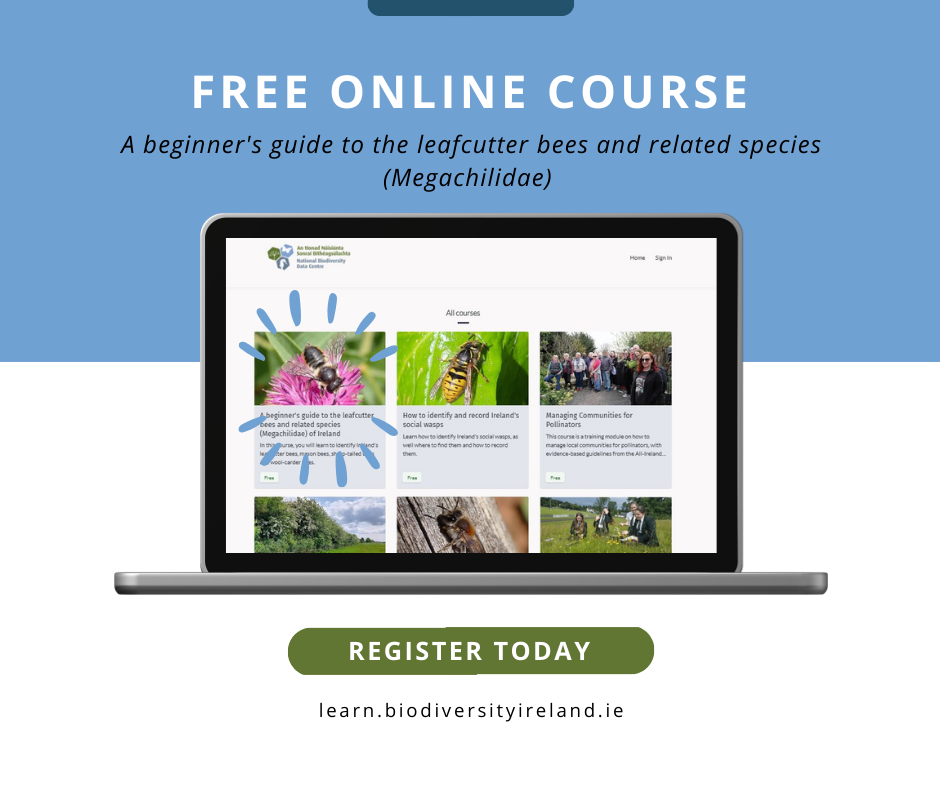
The National Biodiversity Data Centre is delighted to announce the launch of a new online course on Ireland’s leafcutter bees, mason bees, sharp-tailed bees and wool carder bees.
Ireland is home to over 100 different bee species, most of which are solitary. Unlike bumblebees or the Honey Bee, these bees do not form colonies, instead they choose to nest solitarily. They are important pollinators and many of them are among our most widespread and familiar solitary bees.
Solitary bee declines
With many of our pollinating insects threatened by habitat loss, our need to understand their whereabouts and population status in Ireland has never been greater. Many of our solitary bees have suffered from the removal of native woodlands and the loss of species-rich grasslands, heathlands and coastal dunes. This can reduce the abundance of native wildflowers and the number of available nesting sites which our solitary bees depend on.
The importance of citizen science
The course includes tips on where to find these solitary bees, how to identify them as well as an overview on submitting records on the National Biodiversity Data Centre’s Citizen Science Portal. With more citizen scientists recording solitary bees, we can build a more accurate picture of how these important pollinators are faring. The value of citizen science has already been demonstrated with the discovery of the Wool Carder Bee (Anthidium manicatum) and several other solitary bees in Ireland over the past 10 years, all thanks to you!
Enrolling in the course
With spring just around the corner, many of our solitary bees are starting to emerge, so now is the perfect time to enroll in the course and improve your identification skills. The course is completely free and can be accessed on the National Biodiversity Data Centre’s online learning platform here: A beginner’s guide to the leafcutter bees and related species (Megachilidae) of Ireland