
Insects encompass some of our most familiar and well recorded species. Many people will be familiar with the Peacock butterfly (Inachis io) or the 7-spot Ladybird (Coccinella septempunctata), which are bold and conspicuous insects that are recorded in their hundreds across Ireland each year. But of the 11,000 different insect species that are known in Ireland, many are small, elusive or difficult to identify, which often leaves room for unusual discoveries. With a warming climate and an ever-changing landscape, new insects from elsewhere in the world are also arriving in Ireland and many of these are beginning to colonise.
In the past few years, over 30 insect species have been found in Ireland for the first time. Some of these are believed to have been here for a long time, but they have been overlooked in the past. Others have only arrived recently but are already established and beginning to spread.
Many of these new discoveries have been made by our fantastic Citizen Science network and it is a great testament to your knowledge and enthusiasm that we have had so many new discoveries! Here is a brief snapshot of some of these amazing species:
-
![]()
- Colletes hederae (Jim Kenny)

Ivy Bee (Colletes hederae) – Jim Kenny, Co. Wexford
Recorder Jim Kenny first noticed a large collection of nesting holes in the sand and several thousand bees during a visit to The Raven Nature Reserve, Co. Wexford in October 2021. These bees were identified by our entomologist Owen Beckett as the Ivy Bee, which had not yet been found in Ireland. This bee has been spreading throughout Europe was expected to reach Ireland eventually. It is similar in size to the Honey Bee, but it has bold orange stripes on its abdomen and denser, orange-coloured hair.
It lives solitarily in holes in the ground and tends to visit Ivy flowers during September and October. Since its initial discovery, the Ivy Bee has found more widely, as far west as St. Mullin’s, Co. Carlow and as far north as Arklow, Co. Wicklow. It is likely to continue spreading throughout Ireland and is one to watch out for on Ivy flowers during the autumn.
We are interested in tracking the expansion of the Ivy Bee in Ireland, so if you think you’ve seen one, please submit your record with a photograph here: https://records.biodiversityireland.ie/record/solitary-bees
-
![]()
- Hippodamia variegata (Marcus Maher)

Adonis Ladybird (Hippodamia variegata) – Co. Dublin
The first appearance of the Adonis Ladybird in Ireland was in June 2020, when one was photographed in a garden in Glasnevin. Further sightings took place in Stillorgan in July 2022 by recorder Sr Fionnuala O’Connor, and in Kilmainham in August 2023 by recorder Marcus Maher. It is similar in appearance to our common 7-spot Ladybird, but it is smaller in size with a more flattened, elongated body shape. The black spots are also positioned in a slightly different arrangement.
This ladybird is fairly common in dry, flowery habitats in southern and central Britain and has been expanding there over the past few years. It is possible that it was able to fly across the Irish Sea to Dublin, or it may have hitched a ride on imported plants. It now appears to be established in Dublin and it will likely spread over the coming years.
The National Biodiversity Data Centre is currently gathering records for the upcoming Ladybird Atlas 2025. If you’ve seen the Adonis Ladybird or any of our other ladybird species, then please submit your records with a photograph here: https://records.biodiversityireland.ie/record/ladybirds
-
![]()
- Cassida vittata (Brian Power)

Bordered Tortoise Beetle (Cassida vittata) – Brian Power and Jessica Hamilton, Co. Kerry
This small but striking little beetle was first discovered by ecologists Brian Power and Jessica Hamilton in August 2023 at Black Rock, Co. Kerry. It gets its name from its round, flattened body shape and rather slow movements. It is typically orange-red in colour with two striking lime-green markings. It tends to live in coastal areas, like saltmarshes and estuaries, where plants like Sea Beet, oraches and goosefoots grow. These plants are crucial to the survival of this beetle as they are the main sources of food.
This attractive beetle has probably been in Ireland for a long time but was overlooked in the past, likely due to its shy nature and rather precise habitat and foodplant preferences.
-
![]()
- Volucella zonaria (Killian Mullarney)

Hornet Plumehorn (Volucella zonaria) – Killian Mullarney and David McAdams, Co. Wexford
Ornithologists Killian Mullarney and David McAdams were birdwatching near Carnsore Point, Co. Wexford in July 2023 when they spotted a large hoverfly visiting bramble flowers. Killian posted his photos to the ‘Insects/Invertebrates of Ireland’ Facebook group, where its identity was confirmed as a Hornet Plumehorn (Volucella zonaria), a large species of hoverfly. This species has been spreading northwards and westwards in Britain and its arrival here is likely part of a natural expansion.
Volucella zonaria is the largest hoverfly in Ireland, measuring a impressive 25mm. It gets its common name from the fact that it closely resembles the European Hornet (Vespa crabro) in appearance. Despite this, the two species are unrelated and Volucella zonaria cannot sting; instead it simply mimics the hornet to avoid being eaten. Birds and other predators are far less likely to attempt to eat something which they think is a hornet, as they know they could be in for a nasty sting. Volucella zonaria can be easily distinguished from wasps or hornets as it lacks the narrow ‘wasp waist’, has much shorter antennae and it only has two wings, rather than four. To find out more about it and to distinguish it from other similar species, have a look at hoverfly expert Martin Speight’s guide, which is available here: https://biodiversityireland.ie/publications/
-
![]()
- Eupteryx decemnotata (Ciarán Byrne)

Ligurian Leafhopper (Eupteryx decemnotata) – Ciarán Byrne and John Emmet O’Sullivan, Co. Cork, Co. Laois and Co. Carlow
Ecologist Ciarán Byrne photographed some leafhoppers on Common Sage in Kildavin, Co. Carlow in August 2023, which were later revealed to be Ligurian Leafhoppers. Further research led to other overlooked observations of this leafhopper in Co. Galway and Co. Cork, in June 2018 by Thomas Cuffe and May 2023 by John Emmet O’Sullivan respectively.
The Ligurian Leafhopper is named after the Ligurian Sea in Italy, close to where this species was originally found. It has been spreading rapidly northwards in recent decades, likely due to the movement of sage, rosemary and thyme plants across Europe. The leafhopper needs these plants or other plants in the mint family to survive, as these are its main source of food. It typically measures just a few millimeters in length and is almost always found on its foodplants.
-
![]()
- Anthophora plumipes (Mary Molloy)

Hairy-footed Flower Bee (Anthophora plumipes) – Mary Molloy, Co. Dublin
In March 2022, recorder Mary Molloy spotted several unusual bees in her garden in Dublin. Mary took several photographs of the bees and sent them to our senior ecologist Úna Fitzpatrick, who identified them as Hairy-footed Flower Bees. This was the first confirmed sighting of this bee in Ireland.
Hairy-footed Flower Bees resemble bumblebees in appearance. The female (pictured) is black and hairy with striking orange hindlegs. The male looks quite different, as it is sandy-brown with black legs. The male’s middle pair of legs have unusually long hairs, which give this species its common name. It emerges early in the year, appearing from March – May. It likes to visit tubular flowers like Comfrey, Lungwort, Red Deadnettle and Primrose and it has a fast, darting flight. Since its initial discovery, it has been seen repeatedly in Dublin and has also been found near Enfield, Co. Kildare, which suggests that it is spreading. We are interested in tracking the expansion of the Hairy-footed Flower Bee in Ireland, so if you think you’ve seen one, please submit your record with a photograph here: https://records.biodiversityireland.ie/record/solitary-bees
-
![]()
- Agathomyia cinerea – Jan van Duinen (CC-BY-NC-ND)

A flat-footed fly (Agathomyia cinerea) – Ryan Mitchell, Co. Kildare and Co. Sligo
Fly expert Ryan Mitchell found this unusual fly for the first time in Ireland in September 2022 in Co. Kildare, then in October 2022 in Co. Sligo. This species is one of a number of flat-footed flies in Ireland, small and elusive flies which are usually found in woodlands. This is because their immature stages live in and feed on fungi, particularly bracket fungus and honey fungus. Flat-footed flies can be seen from spring until autumn, but they mainly fly during late summer and autumn, which coincides with the emergence of most fungi.
The adults are only a few millimeters in length with long wings and a ‘hunched’ body shape. They are difficult to find due to their small size and their habit of basking on the leaves of deciduous trees.
-
![]()
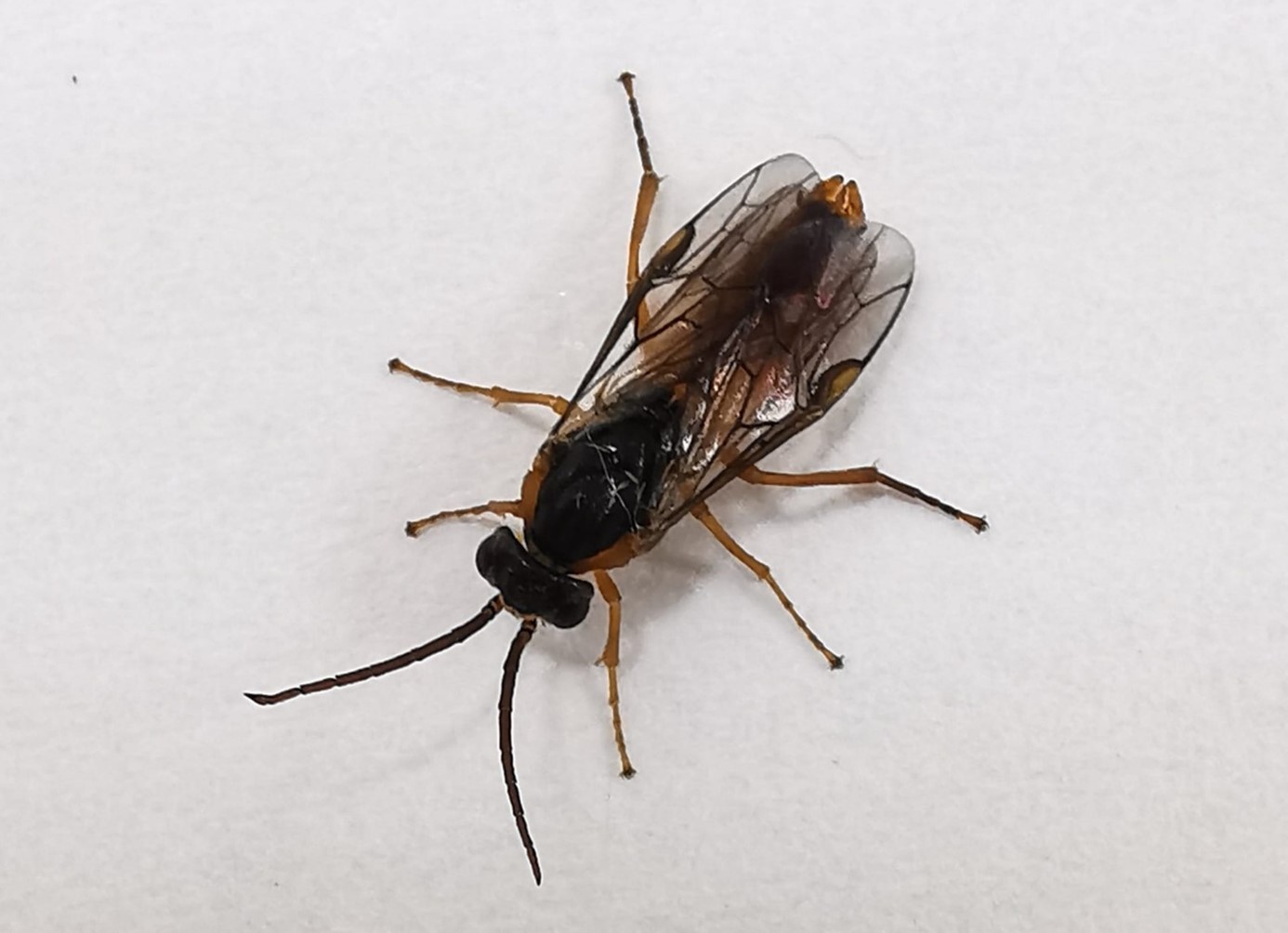
- Pristiphora conjugata (adult) – Rachel McKenna
-
![]()
- Pristiphora conjugata (larvae) – Rachel McKenna

A sawfly (Pristiphora conjugata) – Rachel McKenna, Co. Offaly
Recorder Rachel McKenna first encountered the caterpillar-like larvae of this sawfly feeding on an Aspen leaf whilst walking in Cranberry Bog, Co. Offaly in June 2023. UK sawfly expert Andrew Green was able to identify them, thereby confirming the first occurrence of this species in Ireland.
Sawflies are closely related to bees, wasps and ants and have lifecycles which are similar to butterflies and moths. There are approximately 300 sawfly species in Ireland, each with their own specific foodplants on which the caterpillar-like larvae feed. This particular sawfly is probably a long-established native, but has been overlooked due to its small size, specific foodplant requirements and similarity to other sawflies.
-
![]()
- Scaeva dignota – Mary Duggan

A hoverfly (Scaeva dignota) – Mary Duggan, Co. Cork
Recorder Mary Duggan encountered this impressive hoverfly in June 2019 at Ballinspittle, Co. Cork. Hoverfly expert Dr. Tom Gittings was able to check the photo and confirm its identity as Scaeva dignota, a type of hoverfly which had never been seen in Ireland before. Scaeva dignota is most at home in the warmer climes of southern and central Europe, but it is a strong flyer and likes to wander, so it occasionally turns up further north.
Identification is difficult, but if you think you’ve seen this species or other similar hoverflies, then please submit your records with accompanying photographs here: https://records.biodiversityireland.ie/record/hoverflies
Remember that you can submit records of anything you find on the National Biodiversity Data Centre Citizen Science platform, which is accessible here: https://records.biodiversityireland.ie/start-recording
Your records greatly help to improve our understanding of where particular species are found and how their populations are faring. If you are unsure which species you’ve found then there are lots of resources available to help you. Our new online learning platform (https://learn.biodiversityireland.ie/) contains interactive ID courses and we are currently working on expanding the number of course we offer. There are also a number of digital and hard-copy resources available via our website. Alternatively, you can post photos of your queries on the Insects and Invertebrates of Ireland Facebook group, where experts will be able to assist you.
You can contact our National Insect Database Officer Owen Beckett (obeckett@biodiversityireland.ie) for help, advice and general insect queries.