


Fásra
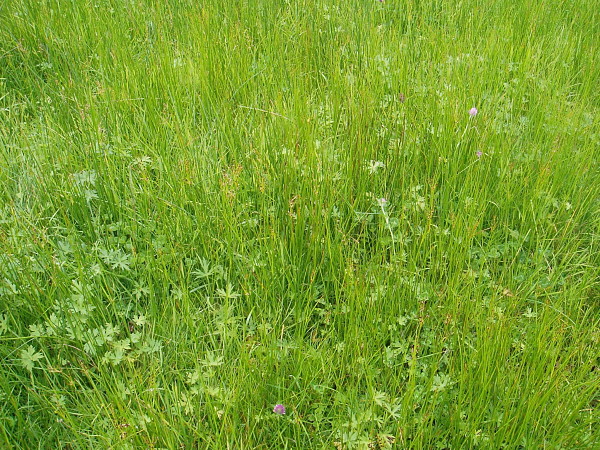
The sward of this wet grassland community is comprised mainly of Holcus lanatus, Juncus acutiflorus, Anthoxanthum odoratum, Juncus effusus and Cynosurus cristatus (mean graminoid height = 34.4 cm, n = 137). The forb component is low growing (mean forb height = 14.5 cm, n = 137) and consists mostly of Trifolium repens, Prunella vulgaris, Ranunculus acris, R. repens and R. flammula, with Cardamine pratensis, Galium palustre, Plantago lanceolata and Cirsium palustre also frequent. The bryophyte layer is quite distinctive, with Rhytidiadelphus squarrosus being abundant and sometimes forming a carpet with Calliergonella cuspidata and Brachythecium rutabulum.
Éiceolaíocht
The Juncus acutiflorus – Rhytidiadelphus squarrosus grassland is found on wet, rather acidic peaty gleys (mean organic content = 30.5%, n = 137) of rather low fertility. It is a lowland farmland community of sloping ground (mean altitude = 99 m, n = 137; mean slope = 4.6°, n = 137).
Fo-phobail
No sub-communities are currently described for this community.
Pobail chosúla
This grassland is more species-rich and less rank than the other main Juncus acutiflorus sward, community GL1A, and also differs in that small sedges are more frequent in the present community, mainly Carex nigra, C. panicea and C. leporina. It differs from the similar GL4D Agrostis canina/vinealis – Rhytidiadelphus squarrosus, in that indicators of upland dry-humid grassland, such as Potentilla erecta, Hylocomium splendens and Luzula multiflora, are less frequent, whilst marsh plants such as Galium palustre, Cardamine pratensis, Ranunculus flammula and Ranunculus repens are more frequent.
Luach caomhnaithe
This is a fairly species-rich grassland community (species/4 m2 = 28.2, n = 160) of which a low proportion of examples correspond with EU HD Annex I habitat 6410 Molinia meadows.
Bainistíocht
These swards are managed as rough grazing land (typically for cattle). The main threats to these grasslands include improvement, abandonment and afforestation.